
AURA FY 2025 Annual Report
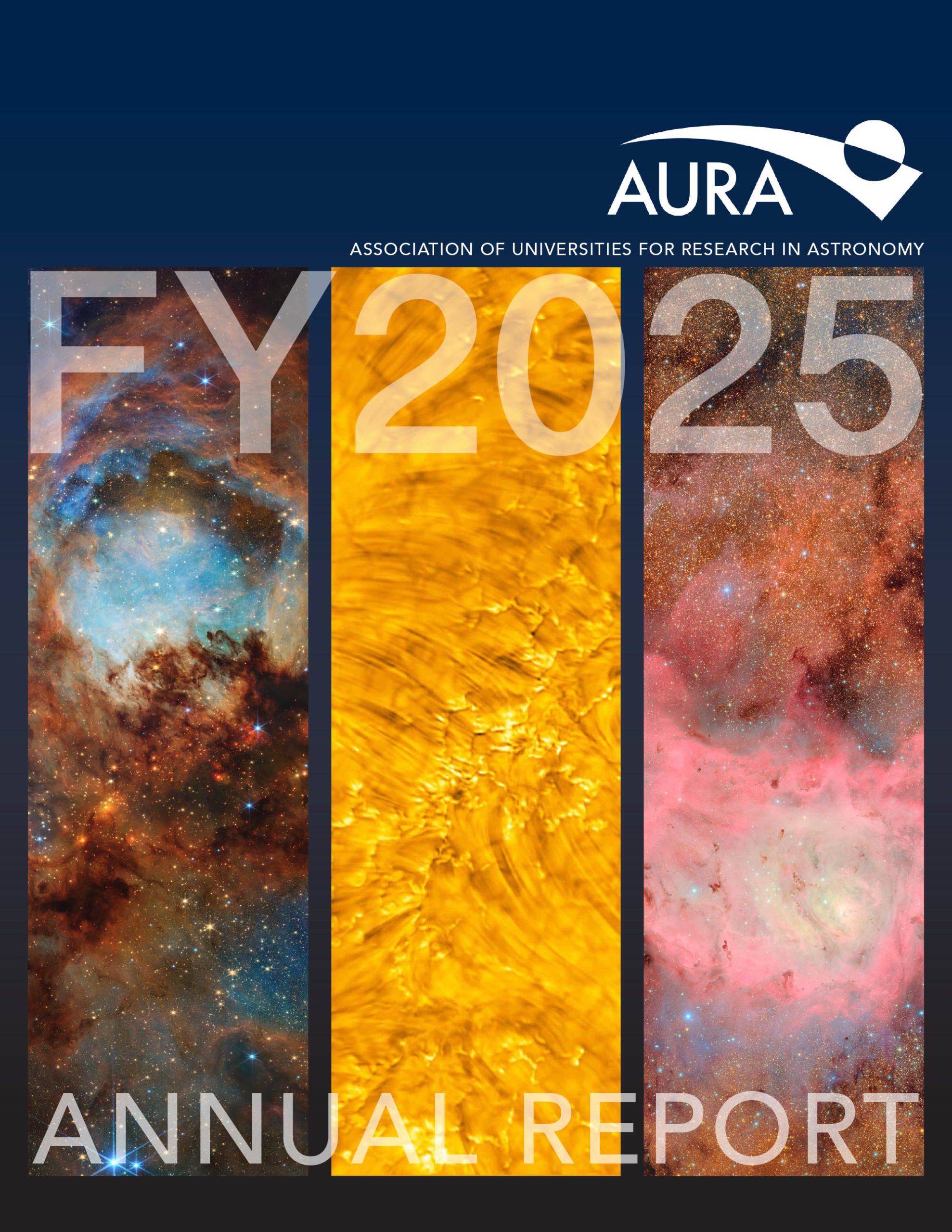
Download a pdf of the AURA FY25 Annual Report.
Contents

As President of AURA, I have been privileged to be part of a truly transformational period in astronomy. Together with all of AURA’s Centers, we have embarked on groundbreaking projects that are expanding our understanding of the Universe and, closer to home, revealing how the Sun’s magnetic fields channel energy into flares and heat the corona.
At our ground-based astronomical center, NSF NOIRLab, the new NSF-DOE Vera C. Rubin Observatory in Chile is transitioning to operations. In June 2025, we celebrated Rubin’s first images, an exciting preview of what is to come from its Legacy Survey of Space and Time. Just during those first observations Rubin identified 4,000 new asteroids. In Hawai‘i, Gemini North discovered the long-predicted stellar companion of Betelgeuse using the ‘Alopeke instrument. Back in Arizona on Kitt Peak, our partners at the Department of Energy used the Mayall Telescope to produce intriguing results from the first three years of the Dark Energy Spectroscopic Instrument. Those results suggest that dark energy, widely thought to be a cosmological constant, may actually be evolving over time.
At the Space Telescope Science Institute, the NASA/ESA/CSA James Webb Space Telescope continues to excite astronomers and inspire the public with its remarkable observations and images. Webb has observed the farthest galaxy known to date, revealed massive early galaxies, probed the atmospheres of exoplanets, and discovered a new moon orbiting Uranus. NASA’s Hubble Space Telescope celebrated its 35th year in space in April, and it remains in high demand, delivering cutting-edge science and spectacular images. NASA’s Nancy Grace Roman Space Telescope, almost ready for launch, will investigate our solar neighborhood and galaxy and probe the mysteries of dark energy and dark matter at near-infrared wavelengths.
At NSF National Solar Observatory, the Daniel K. Inouye Solar Telescope in Hawai‘i, the most powerful solar telescope on the planet, continues to deliver unprecedented high-resolution images of the Sun and the plasma entrained in its complex magnetic fields. These stunning results are giving us new insights into the origins of solar flares and space weather. NSO also received funding from the U.S. National Science Foundation to begin designing the next-generation global network of solar telescopes, ngGONG, which will replace the existing 30-year-old GONG network.
These are just a few examples of the scientific and technological advances from the facilities managed by AURA. This impressive flow of discoveries is a testament to the ingenuity of the scientific communities we support, the dedication and expertise of our talented staff, and the sustained commitment of our agency partners at NSF, NASA, and the Department of Energy Office of Science. It is this extraordinary collaboration that enables AURA’s facilities to operate at a unique scale in observational astrophysics, producing 2,000 refereed publications last year alone. Those papers represent contributions from a substantial share of the global professional community — fulfilling our mission to provide open access to world-class facilities, tools, and resources that enable discovery and excellence in astrophysics and solar physics.
Though past performance is not always a reliable guide, if this past year is any indication, I, for one, cannot wait to see what the future holds for astronomical discovery.

The Association of Universities for Research in Astronomy (AURA) was founded in 1957 to establish, nurture, and promote public, state-of-the-art observatories and facilities that advance astronomical research.
AURA Today
AURA, headquartered in Washington D.C., manages world-class astronomical Centers for both the U.S. National Science Foundation (NSF) and the National Aeronautics and Space Administration (NASA). Our Centers enable the next decade of astronomical discoveries through world-class facilities and science.
Building on our origin in broadening access and opportunities for all astronomers, AURA is committed to providing the astronomical community with open access to the world-class facilities it manages. Telescope time is allocated based on merit in a dual anonymous selection process. Our data archives open observational data to anyone, and support thousands of science papers each year.
AURA is also committed to sharing the wonders of the Universe with the public through outreach, educational events, and press releases. AURA’s talented communication, education, and outreach teams reach millions of people with the excitement of astronomical discoveries and inspiring images of our Universe.
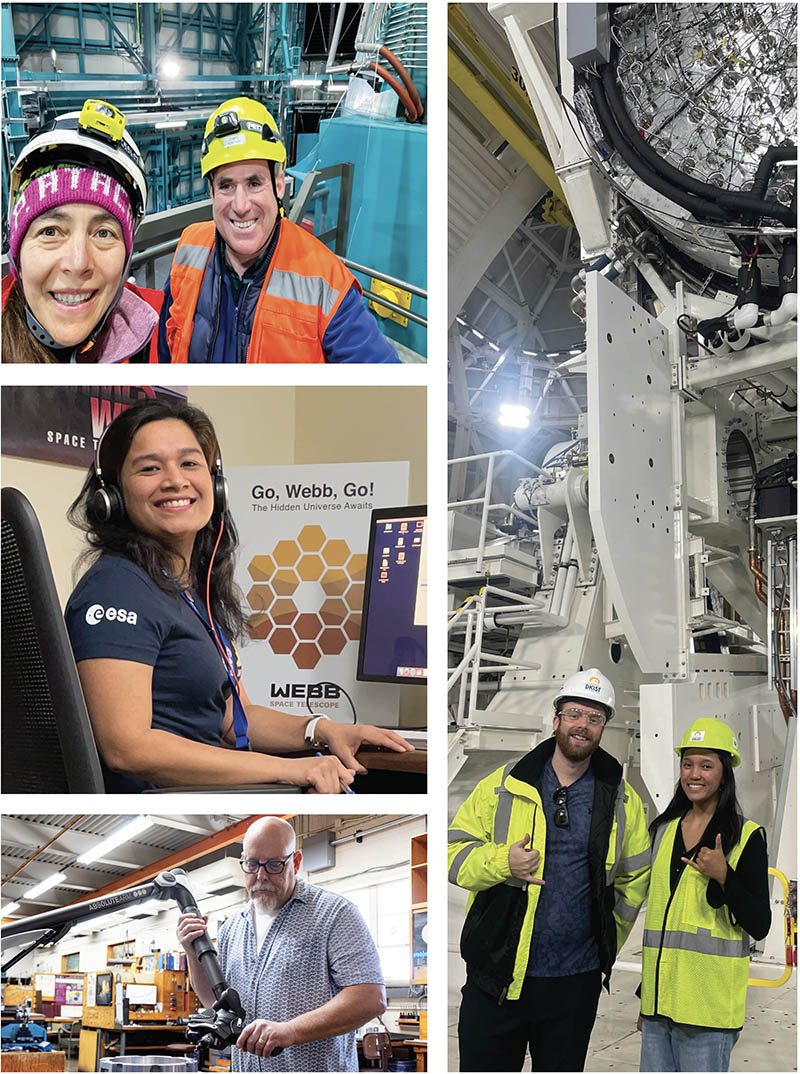
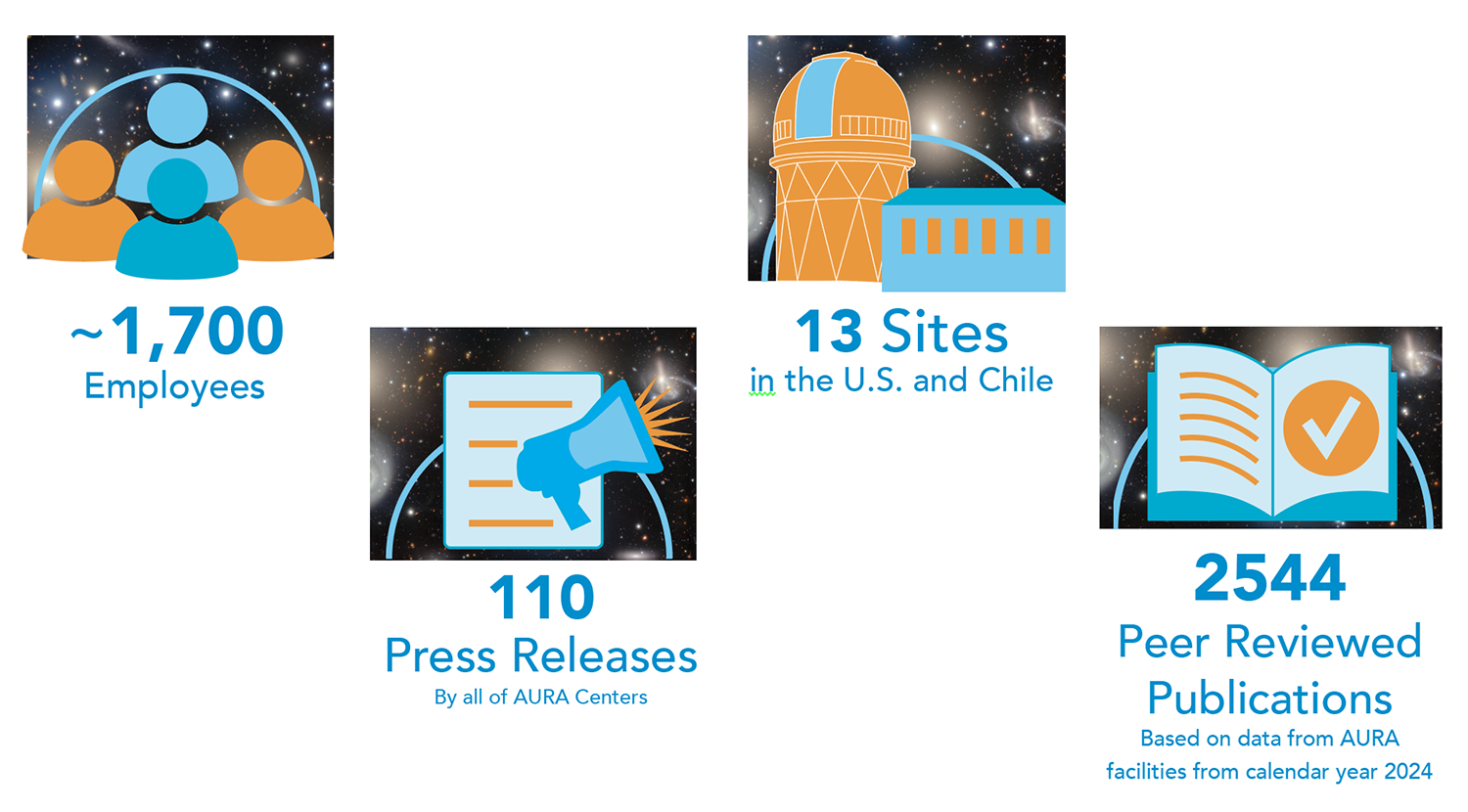
To achieve its mission, AURA employs approximately 1700 highly skilled professionals at its three Centers, construction projects, and corporate headquarters. Our staff work at multiple locations in the continental United States, Hawai‘i, and Chile, and build, operate, and support state-of-the-art facilities, data centers, and science platforms. Our workforce spans time zones and international locations, professional disciplines, education levels, and an enormous breadth of perspectives, capabilities, and contributions.
Future of Astronomy
Looking to the future, AURA fully supports the scientific vision of Pathways to Discovery in Astronomy and Astrophysics for the 2020s and joins with our community to advocate for its recommendations and highest prioritized scientific goals: “Pathways to Habitable Worlds, New Windows on the Dynamic Universe, and Unveiling the Drivers of Galaxy Growth.” As the operational home for observatories spread across the globe and in space, we stand ready to build on our experience and assist our community to implement the Pathways to Discovery recommendations for both ground- and space-based astronomy.
AURA works with community members to continue and enhance our programs in alignment with Decadal recommendations, promote sustainable practices, and coordinate with our partners in the preservation of dark and quiet skies. Through NSF NOIRLab, we will continue a leading role in assessing impacts of satellite constellations on astronomy.
AURA also fully supports the Decadal Survey for Solar and Space Physics (Heliophysics) 2024-2033 which presents a prioritized strategy of basic and applied research to advance scientific understanding of the Sun, Sun-Earth connections and the origins of space weather, the Sun’s interactions with other bodies in the solar system, the interplanetary medium, and the interstellar medium. Besides excitement for the NSF Daniel K. Inouye Solar Telescope’s ongoing, and anticipated, contributions to the field, one of its NSF NSO-related recommendation for the next decade is the development of the next-generation Global Oscillation Network Group (ngGONG).
Since 1957 AURA has enabled discovery with world-class astronomical observatories and data, unified astrophysics communities, and promoted public engagement and understanding of our Universe. Today, AURA continues to advance this legacy, driving scientific progress while broadening access to the wonders of the cosmos.
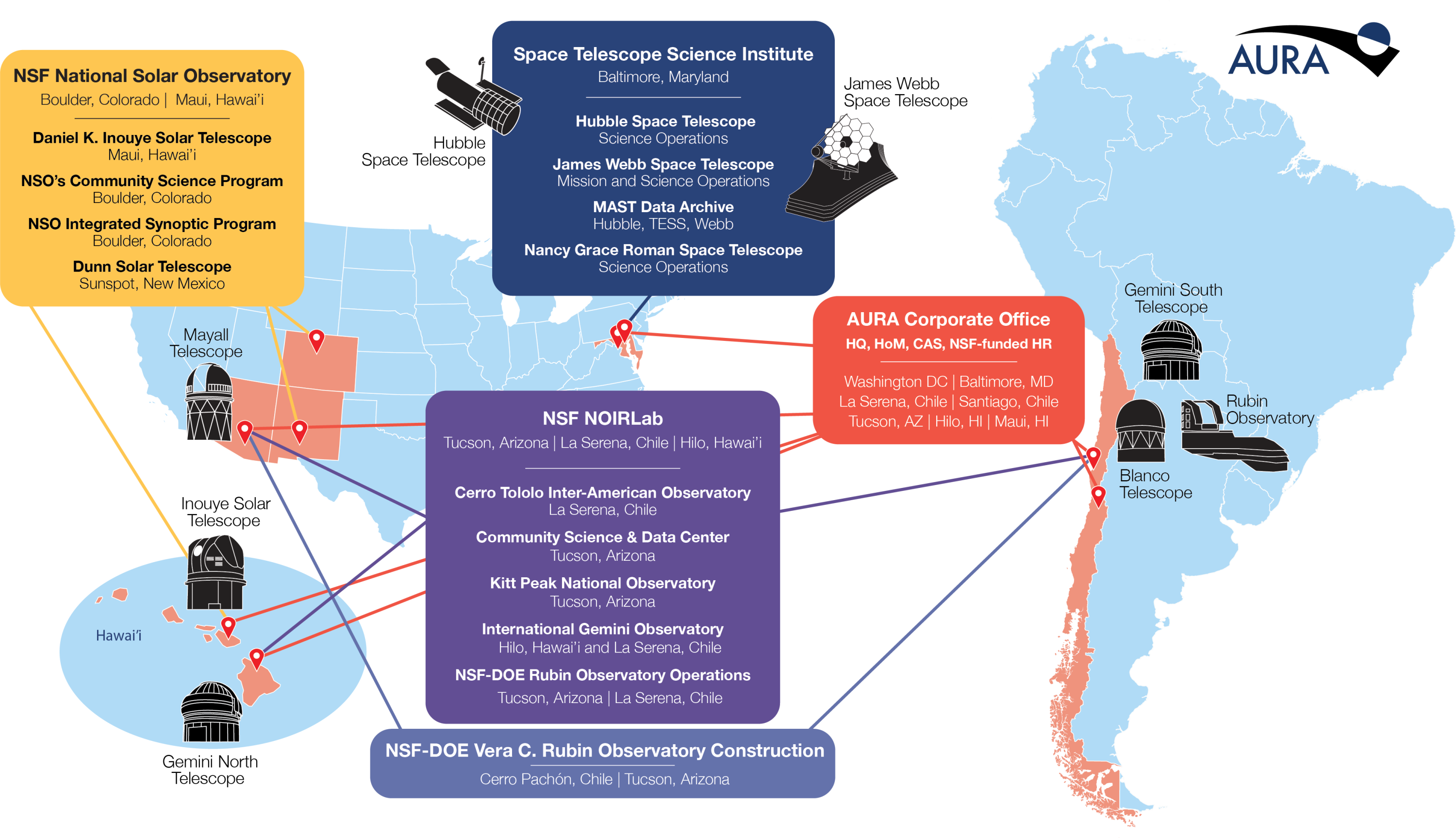
For NSF, AURA operates NSF NOIRLab, located in Tucson, Arizona, La Serena, Chile and Hilo, Hawai‘i, and the NSF National Solar Observatory (NSO) located in Boulder Colorado and Maui, Hawai‘i. AURA also manages the NSF-DOE Vera C. Rubin Observatory construction project in Chile. For NASA, AURA operates the Space Telescope Science Institute (STScI) in Baltimore, Maryland.
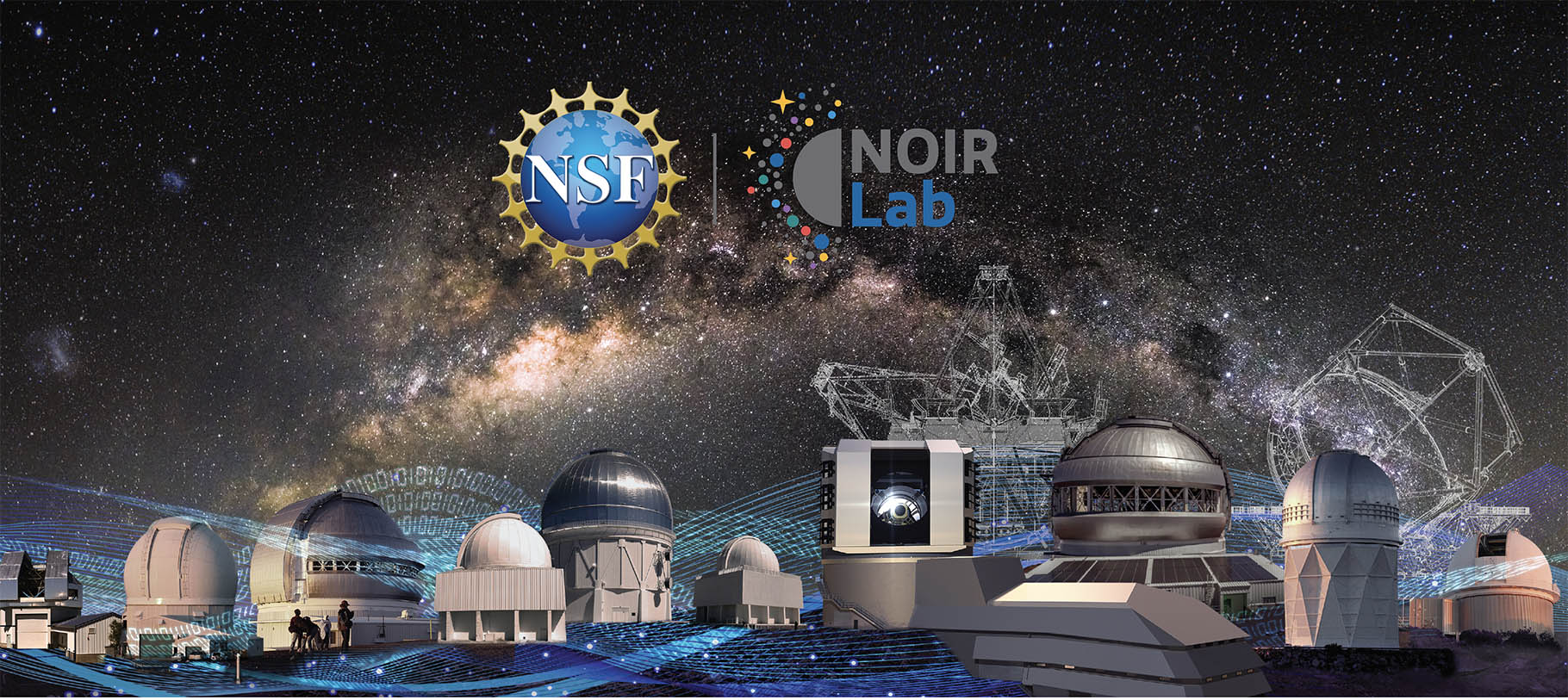
NSF NOIRLab is the preeminent U.S. national center for ground-based, nighttime optical and infrared astronomy. NOIRLab enables breakthrough discoveries in astrophysics by developing and operating state-of-the-art observatories and providing data products and services for the astronomical community.
Through its five programs — Cerro Tololo Inter-American Observatory, the Community Science and Data Center, International Gemini Observatory, Kitt Peak National Observatory and the Vera C. Rubin Observatory once operational — U.S. National Science Foundation (NSF) NOIRLab serves as a focal point for community development of innovative scientific programs, the exchange of ideas, and creative development. The lab’s infrastructure enables the astronomy community to advance humanity’s understanding of the Universe by exploring significant areas of astrophysics, including dark energy and dark matter, galaxies and quasars, the Milky Way, exoplanets, and small bodies in our own Solar System.
NOIRLab enhances the strengths of each facility and provides new opportunities for staff while expanding scientific capabilities and improving the experience for users. By providing cutting-edge facilities that benefit both the staff and the scientific community, the lab positively impacts ground-based nighttime astronomical science. In addition, the lab focuses on developing international collaborations and partnerships to advance ground-based optical and infrared facilities and capabilities.
In collaboration with the astronomical community, partner organizations, other US optical and infrared system operators, and NSF, NOIRLab develops and advances a strategic vision for NSF-funded future optical and infrared facilities.
NOIRLab’s sites are located in Tucson, Arizona, La Serena, Chile and Hilo, Hawai‘i. AURA operates these facilities and NSF NOIRLab under a cooperative agreement with NSF.
Released in celebration of Gemini North’s 25th anniversary, NGC 4449 is a prime example of starburst activity caused by interacting of galaxies.
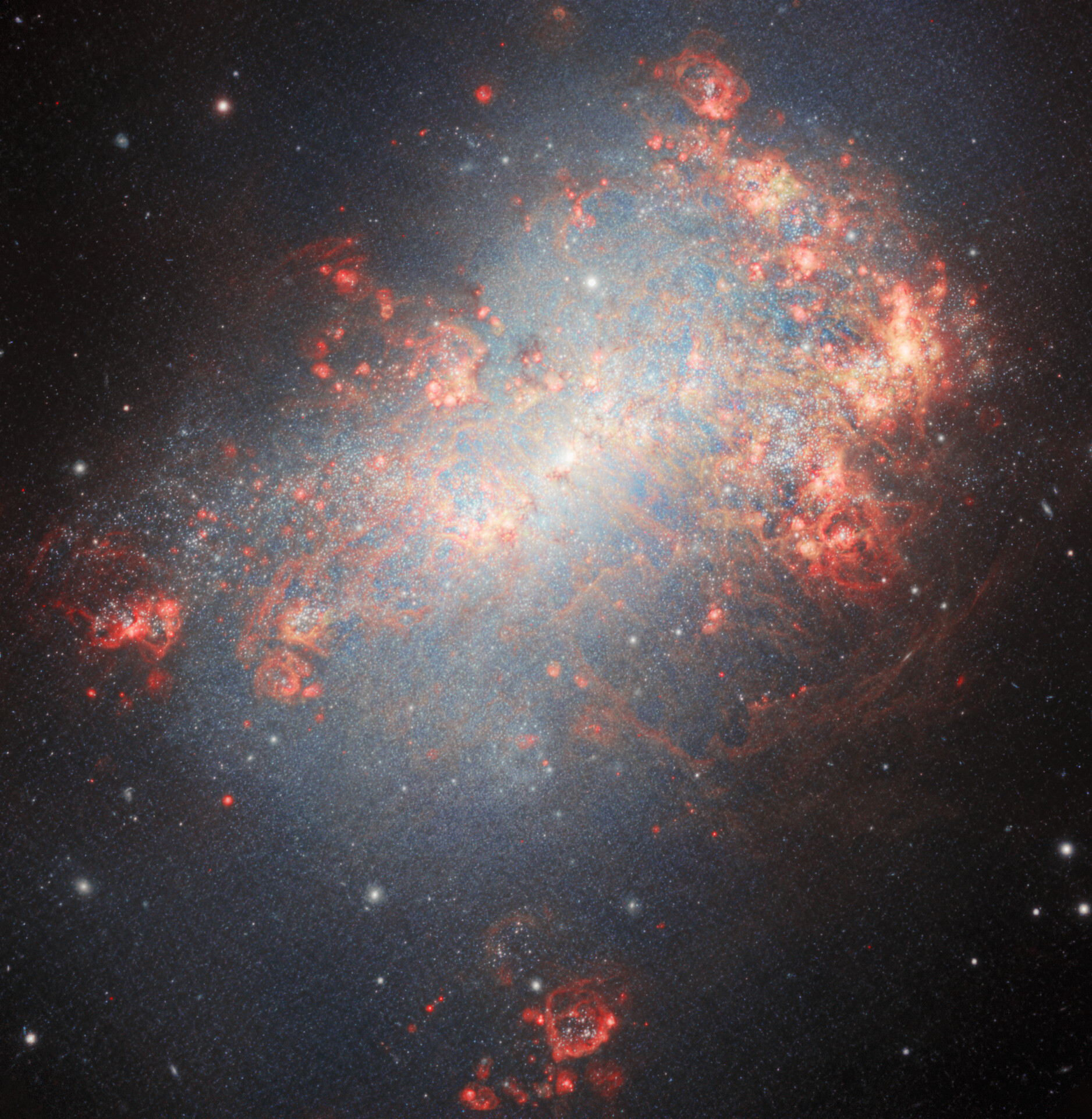
NGC 4449, also known as Caldwell 21, appears to be putting on a cosmic fireworks show in this image captured with the Gemini North telescope, one half of the International Gemini Observatory, which is supported in part by NSF and operated by NSF NOIRLab. The galaxy’s billowing red clouds and sparkling blue veil are lighting up the sky with the colors of newly forming stars. It’s classified as an irregular Magellanic-type galaxy, reflecting its loose spiral structure and close resemblance to the Large Magellanic Cloud — the prototype of Magellanic galaxies.
Stars have been actively forming within NGC 4449 for several billion years, but currently it is pumping out new stars at a much higher rate than in the past. This unusually explosive and intense star formation activity qualifies it as a starburst galaxy. While starbursts usually occur in the central regions of galaxies, NGC 4449’s star formation is more widespread, evidenced by the fact that the youngest stars are both in the nucleus and in streams surrounding the galaxy.
Space Telescope Science Institute (STScI) is a multi-mission operations center for NASA’s flagship observatories and a world-class astronomical research center. Operated by AURA for NASA, STScI has helped guide the most famous observatory in history, the Hubble Space Telescope.
Since the launch of the Hubble Space Telescope in 1990, STScI has performed its science operations. Today, Hubble continues to revolutionize astronomy and expand our knowledge of the Universe and has accounted for 1.6% of the world’s scientific return across all science fields since 1990.
STScI also leads the science and mission operations for the James Webb Space Telescope (JWST), which launched on December 25, 2021. The JWST Mission Operations Center, which sends commands for the observatory to execute, monitors its operational health, and receives scientific data on a daily basis is hosted at STScI.
The selection of the scientific programs for both JWST and Hubble is coordinated by STScI. Every year during science operations, the world-wide community of scientists are invited to submit observing proposals. STScI is also responsible for optimizing and characterizing the performance of Hubble’s and JWST’s science instruments.
STScI is also the science operations center for the Nancy Grace Roman Space Telescope, in development for launch in late 2026, and is a partner on several other NASA missions.
Staff at STScI conducts world-class scientific research; the Barbara A. Mikulski Archive for Space Telescopes (MAST) curates and disseminates data from over 20 astronomical missions; and STScI brings science to the world through internationally recognized news, education, and public outreach programs.
Looking forward, STScI is working on the Habitable Worlds Observatory, NASA’s next flagship observatory for the 2030s. Habitable Worlds Observatory is envisioned as a true “super Hubble” to not only tackle one of humanity’s oldest questions — Are we alone? — but also to also pursue enduring and emerging questions across all of astrophysics and cosmic origins, from cosmology to the life cycles of galaxies, stars, and planets.
NASA’s James Webb Space Telescope finds the most distant known galaxy to date – only two hundred and ninety million years after the big bang.
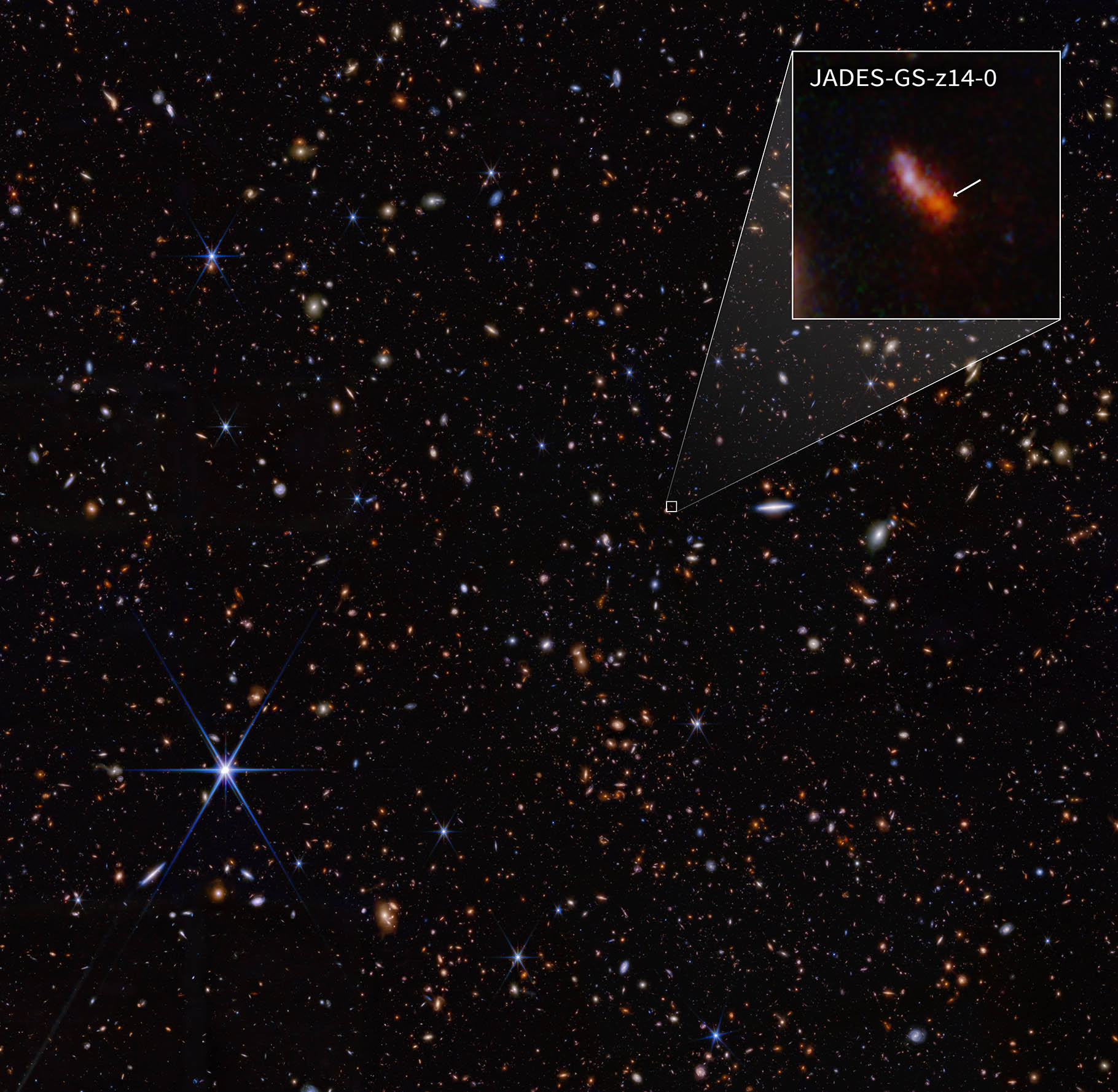
Over the last two years, scientists have used NASA’s James Webb Space Telescope to explore what astronomers refer to as Cosmic Dawn – the period in the first few hundred million years after the big bang where the first galaxies were born. These galaxies provide vital insight into the ways in which the gas, stars, and black holes were changing when the universe was very young. In October 2023 and January 2024, an international team of astronomers used Webb to observe galaxies as part of the JWST Advanced Deep Extragalactic Survey (JADES) program. Using Webb’s NIRSpec (Near-Infrared Spectrograph), they obtained a spectrum of a record-breaking galaxy observed only two hundred and ninety million years after the big bang. This corresponds to a redshift of about 14, which is a measure of how much a galaxy’s light is stretched by the expansion of the universe.
Note: This is data from Webb science in progress, which has not yet been through the peer-review process.
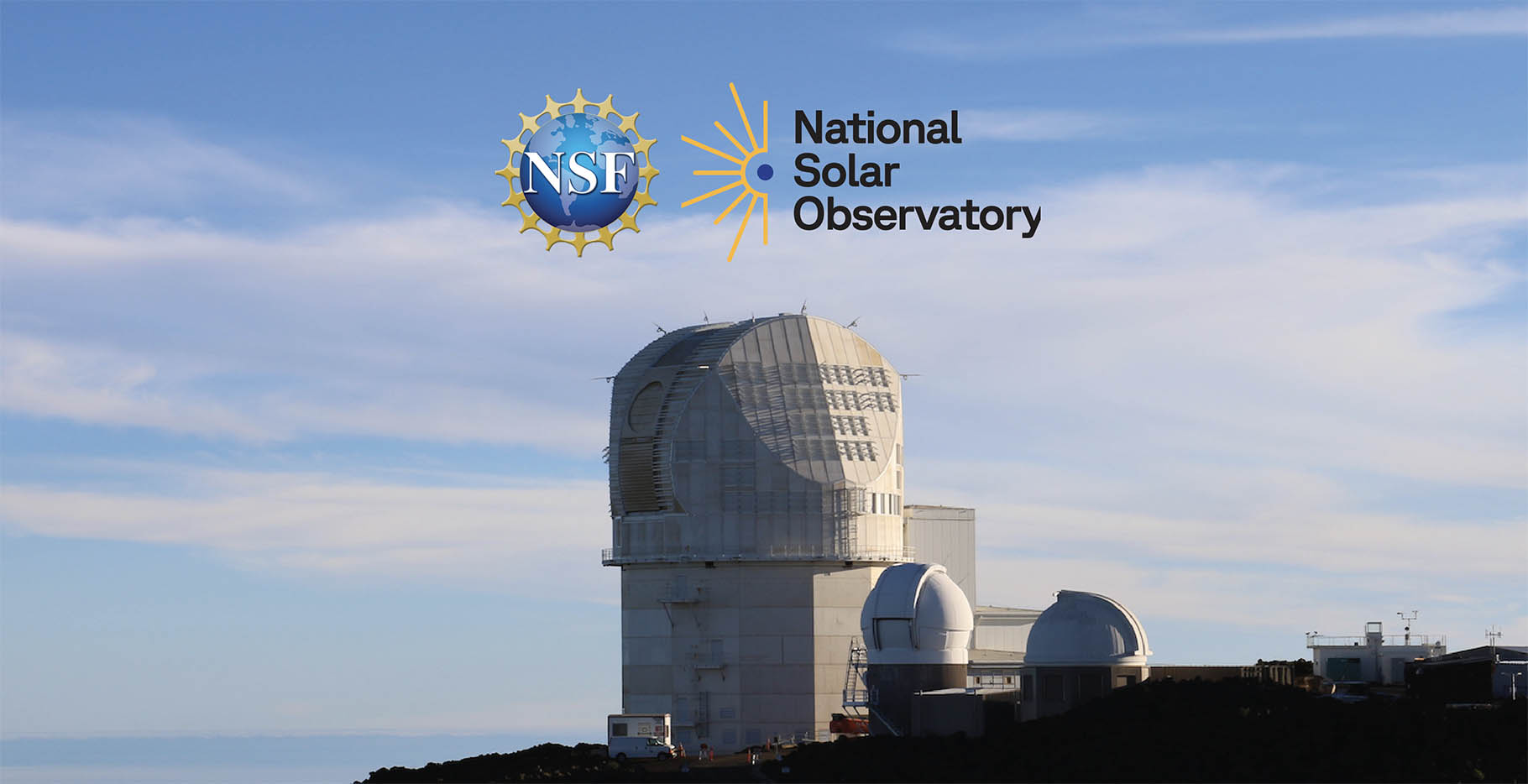
The NSF National Solar Observatory (NSO) operates the world’s most extensive collection of ground-based optical and infrared solar telescopes and auxiliary instrumentation, allowing solar physicists to probe all aspects of the Sun.
The U.S. National Science Foundation (NSF) National Solar Observatory (NSO) supports facilities that provide forefront observational opportunities for the solar research community, and leads the operation of the Daniel K. Inouye Solar Telescope on Maui in Hawai‘i, built by the NSO and completed in 2021.
The Inouye Solar Telescope, a collaboration of 22 institutions, is the largest and most advanced solar telescope in the world, with unprecedented abilities to view details of the Sun. Using adaptive optics technology and a 4-meter telescope, Inouye explores physical processes that link the Sun to the Earth, and will set the stage to develop enhanced predictive capabilities of explosive solar events that drive geomagnetic storms. Inouye also furthers our understanding of other stars by allowing scientists to study fundamental physical processes that occur on their surfaces.
NSO also operates the Synoptic Optical Long-term Investigations of the Sun (SOLIS) and the Global Oscillation Network Group (GONG). SOLIS observes the Sun over decades to understand the solar activity cycle, solar irradiance changes, and energy releases in the solar atmosphere. GONG is a six-station network of extremely sensitive solar imagers located around Earth. GONG provides continuous imaging of the Sun and its solar magnetic field, and has been identified as a crucial asset for space weather operational forecasting.
AURA operates NSO under a cooperative agreement with NSF.
The NSF Daniel K. Inouye Solar Telescope captured the sharpest-ever images of a solar flare, revealing dark coronal loop strands in unprecedented detail.
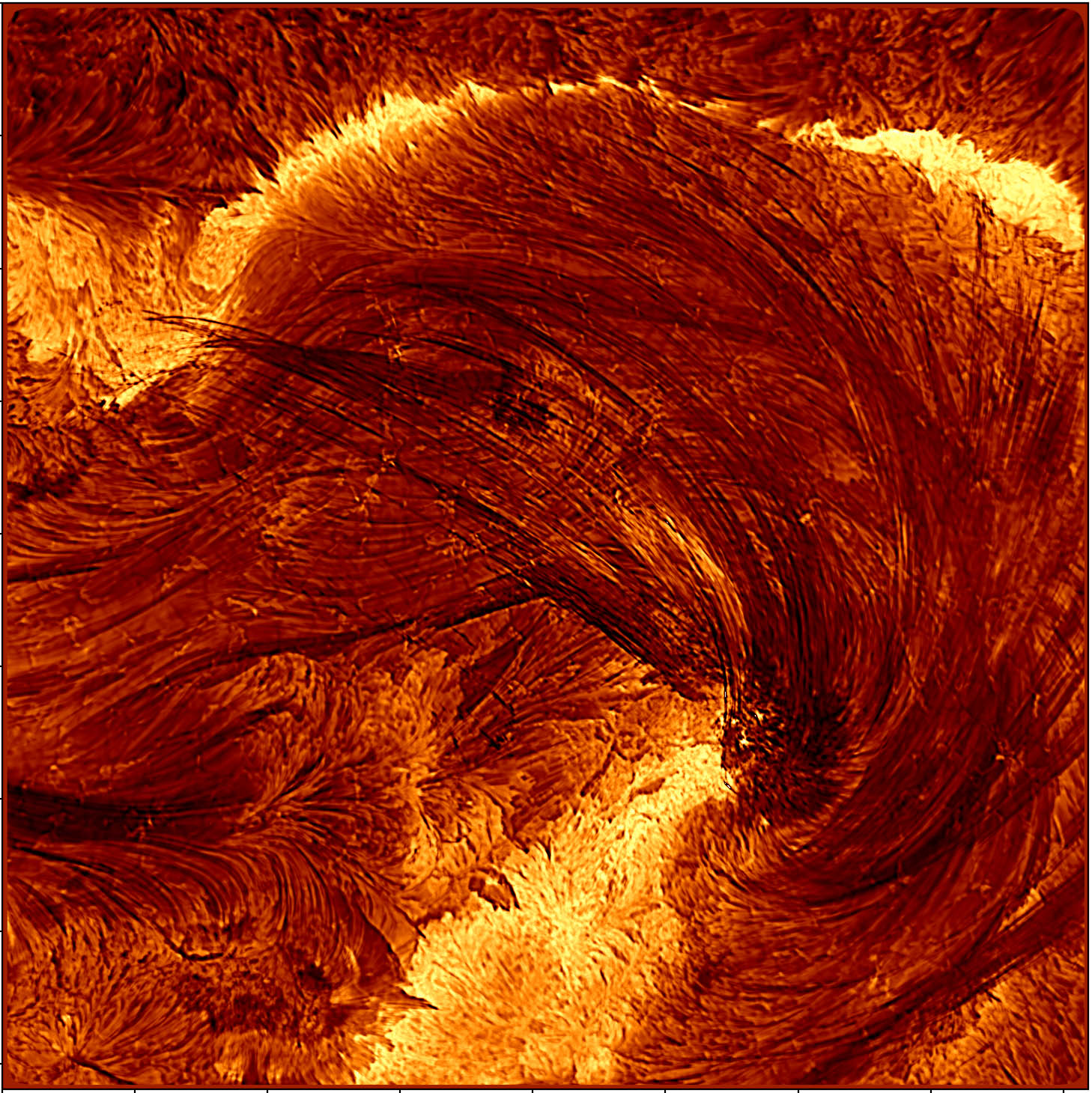
The highest-resolution images of a solar flare ever captured at the H-alpha wavelength (656.28 nm) may reshape how we understand the Sun’s magnetic architecture—and improve space weather forecasting. Using the U.S. National Science Foundation (NSF) Daniel K. Inouye Solar Telescope, astronomers captured dark coronal loop strands with unprecedented clarity during the decay phase of an X1.3-class flare on August 8, 2024, at 20:12 UT. The loops averaged 48.2 km in width—perhaps as thin as 21 km—the smallest coronal loops ever imaged. This marks a potential breakthrough in resolving the fundamental scale of solar coronal loops and pushing the limits of flare modeling into an entirely new realm.
Coronal loops are arches of plasma that follow the Sun’s magnetic field lines, often preceding solar flares that trigger sudden releases of energy associated with some of these magnetic field lines twisting and snapping. This burst of energy fuels solar storms that can impact Earth’s critical infrastructure. Astronomers at the Inouye observe sunlight at the H-alpha wavelength (656.28 nm) to view specific features of the Sun, revealing details not visible in other types of solar observations.
By improving researchers’ ability to model solar flares, these observations will also improve forecasting for space weather events that are hazardous to satellites, power grids, and communications on Earth.
NSF-DOE Vera C. Rubin Observatory, currently under construction by AURA on Cerro Pachón in Chile, is an 8-meter-class telescope coupled to a 3200 megapixels camera – the world’s largest digital camera ever fabricated for optical astronomy. Rubin Observatory will bring the sky to life and revolutionize the way we explore the cosmos.
The U.S. National Science Foundation (NSF) and the U.S. Department of Energy (DOE) Office of Science Vera C. Rubin Observatory will advance science in four main areas: the nature of dark matter and understanding dark energy, cataloging the Solar System, exploring the changing sky, and Milky Way structure and formation.
The observatory will operate on an automated cadence, capturing an area the size of 40 full moons with each 30-second exposure and returning to the same area of sky approximately every three nights. Over ten years of operations, hundreds of deep exposures will be acquired for every part of the visible sky. Dedicated computer facilities will process Rubin Observatory data in real time, issuing worldwide alerts within 60 seconds of detected changes in the sky.
A subset of data will be widely available through the Rubin Observatory Education and Public Outreach dynamic website portal, offering tools and activities for formal educators, citizen scientists, informal science centers, and the general public to engage, explore, and discover.
NSF and DOE will support Rubin Observatory in its operations phase to carry out the 10-year Legacy Survey of Space and Time. They will also provide support for scientific research with the data.
During operations, NSF funding is managed by AURA under a cooperative agreement with NSF, and DOE funding is managed by SLAC National Accelerator Laboratory (SLAC), under contract by DOE. Rubin Observatory will be operated by NSF NOIRLab and SLAC.
Ever-changing Universe Revealed in First Imagery From NSF–DOE Vera C. Rubin Observatory
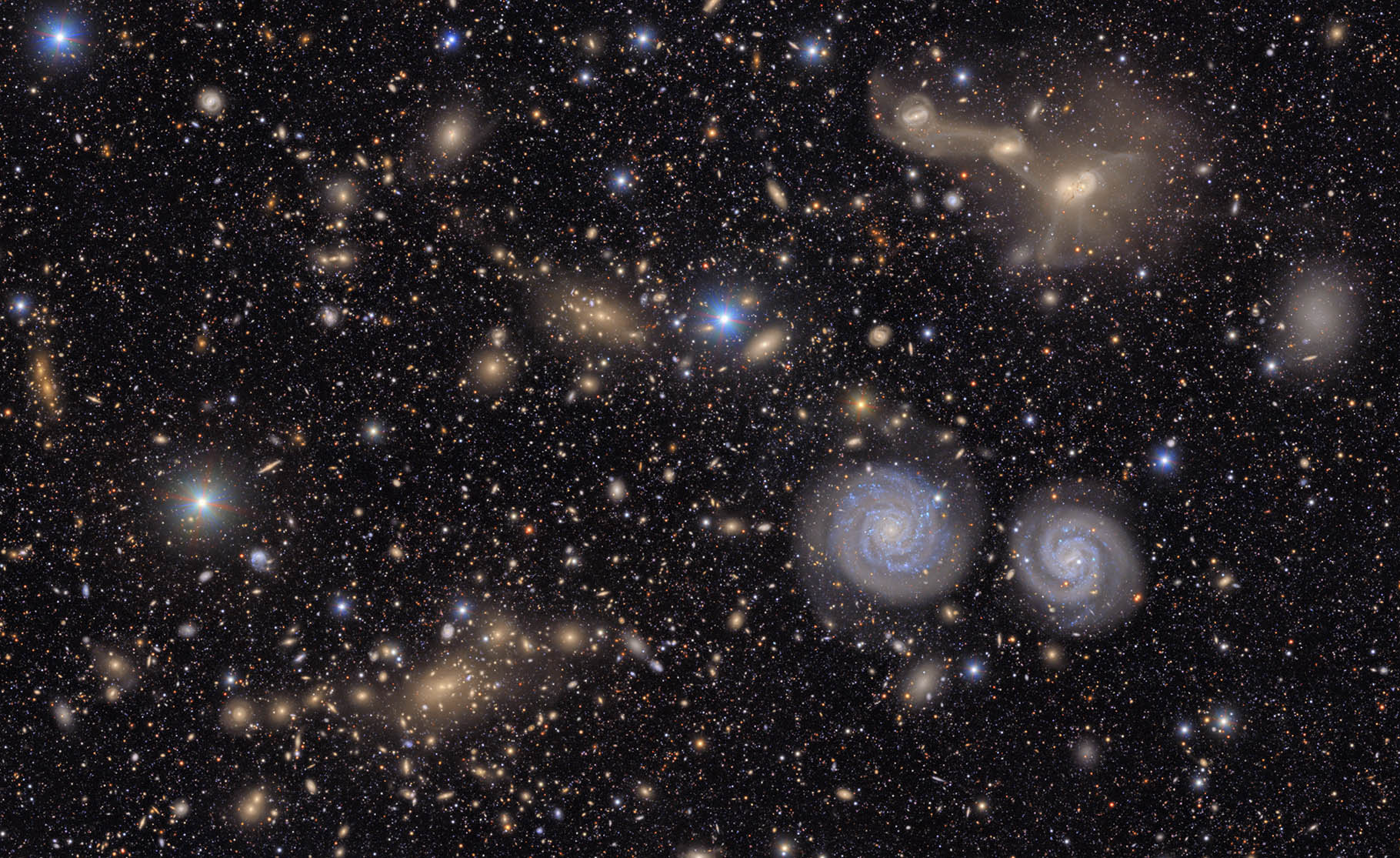
From distant stars and galaxies to asteroids whizzing through the solar system, the NSF-DOE Vera C. Rubin Observatory unveiled its first imagery on June 23, 2025 and brought the night sky to life like never before
The imagery shows cosmic phenomena captured at an unprecedented scale. In just over 10 hours of test observations, Rubin Observatory has already captured millions of galaxies and Milky Way stars and thousands of asteroids. The imagery is a small preview of Rubin Observatory’s upcoming 10-year scientific mission to explore and understand some of the universe’s biggest mysteries.
The culmination of more than two decades of work, Rubin Observatory is perched at the summit of Cerro Pachón in Chile, where dry air and dark skies provide one of the world’s best observing locations. Later in 2026, Rubin will begin its primary mission, the Legacy Survey of Space and Time, in which it will scan the sky nightly for 10 years to precisely capture every visible change.
The result will be an ultrawide, ultra-high-definition time-lapse record of the universe. It will bring the sky to life with a treasure trove of billions of scientific discoveries. The images will reveal asteroids and comets, pulsating stars, supernova explosions, far-off galaxies and perhaps cosmic phenomena that no one has seen before.
AURA managed the construction of the NSF-DOE Vera C. Rubin Observatory.
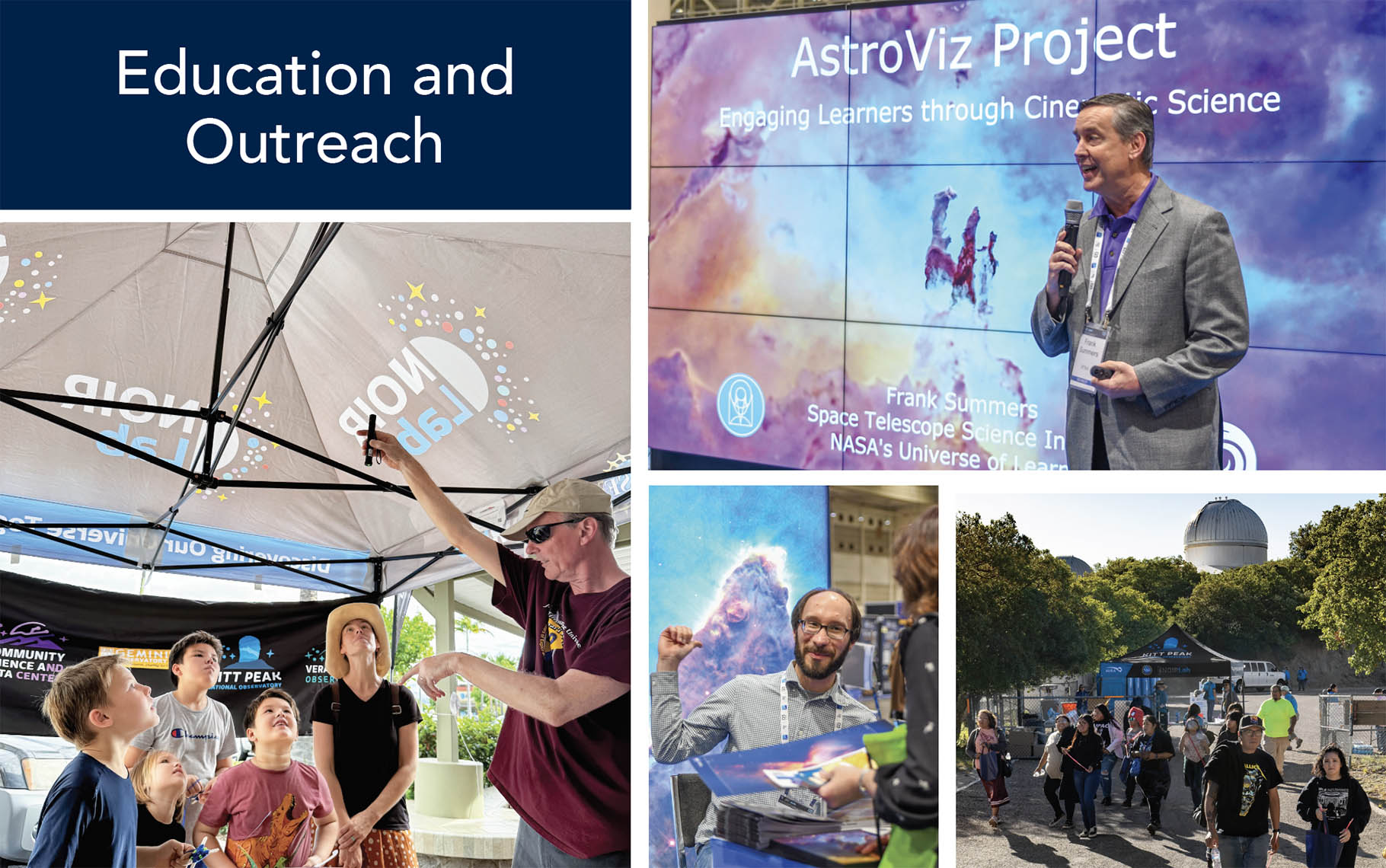
AURA’s mission includes promoting public understanding of our universe and the benefits of scientific exploration. Our talented education and public outreach teams at each of the AURA managed Centers and projects lead this work.
NSF NOIRLab
NOIRLab’s discoveries, facilities, technology, and people are featured in outreach materials in order to strengthen the public’s appreciation of science and the science community’s awareness of NOIRLab’s work. Educational programs increase the science-literacy of K–12 and college audiences.
Over 750 photos, 40 of which are astronomical images, and 4 hours of ultra- and high-definition video, are currently published to the NOIRLab website. NOIRLab releases more than 60 web announcements, 30 press releases, 200 email newsletters, and 4700 social media posts each year.
NOIRLab’s educational programs are wide-ranging and include portable planetariums, dark skies and light pollution awareness, recent astronomical discoveries, and the technology behind telescopes. NOIRLab staff also work closely with local communities at its sites in Arizona, Hawai‘i and Chile.
STScI
Sharing Hubble’s spectacular images and discoveries for more than 25 years by connecting with wide-ranging audiences has made the communications and outreach team at STScI a world leader in astronomy communication and public outreach. They engage the public in mission discoveries at events, create educational programming, develop interactive websites, post to a variety of social media channels, and provide press packages for journalists who publish articles that reach wide audiences. STScI creates authentic science experiences, multimedia resources, scientific visualizations, exhibits, and programming resources for community-based and after-school programs, all of which are based on NASA mission data and discoveries.
NASA’s Universe of Learning provides professional development to strengthen informal educators’ capacities to use astrophysics content to support the needs of their audiences and programs.
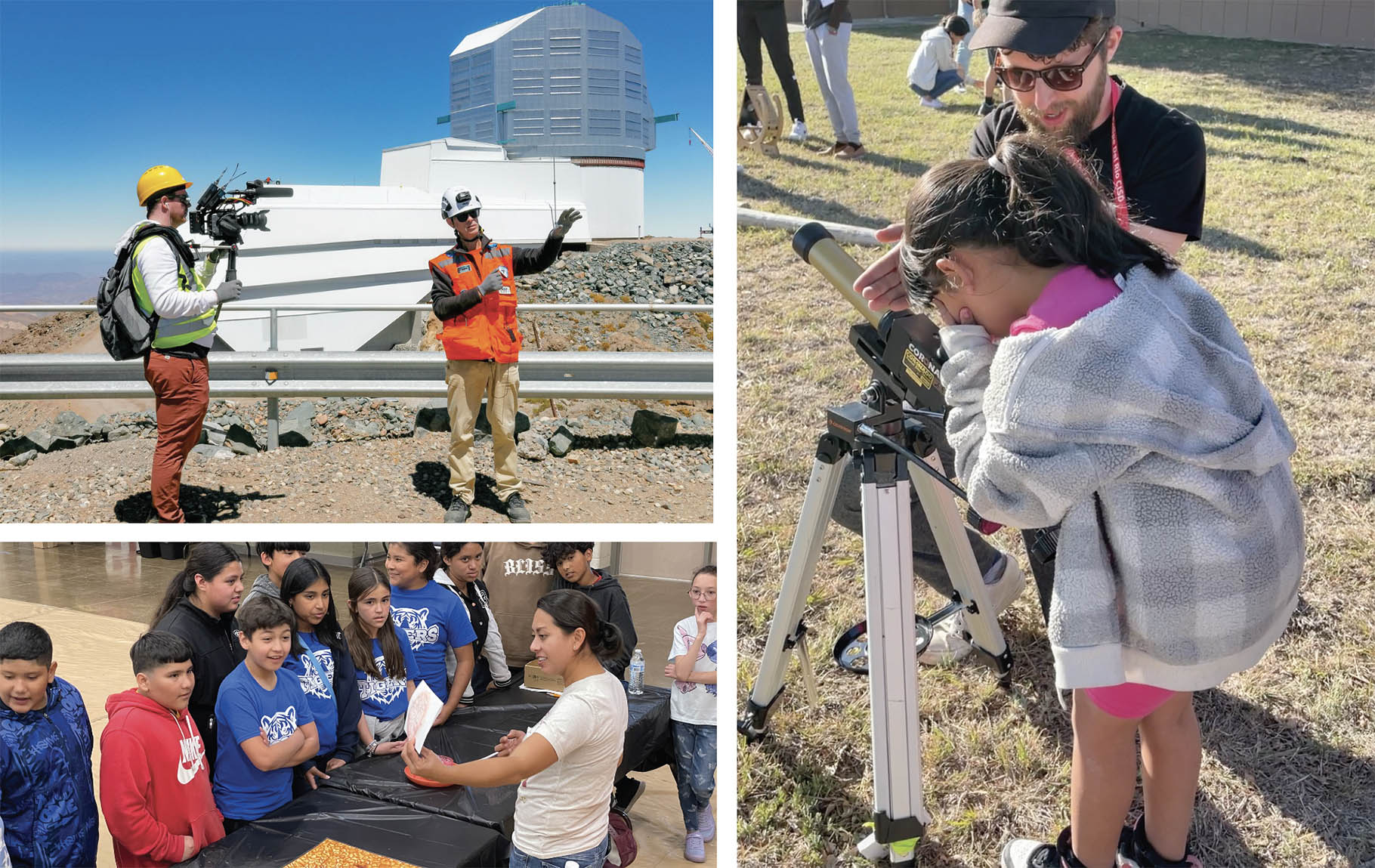
NSF NSO
The NSO Education, Public Outreach & Communications team shares the many stories of solar research, NSO facilities, and the NSO staff and users who make these possible. The team brings the Sun’s invaluable significance to life, inspiring public curiosity while amplifying the scientific results enabled by NSO facilities. Its efforts ensure that knowledge of solar physics reaches a broad and diverse audience—including scientists, engineers, policy makers, educators, and the public—while also strengthening NSO’s engagement with its user community to extend the reach and impact of its resources.
The team’s work includes education, by supporting formal and informal learning from elementary school through college; engagement, by strengthening connections with those outside the organization; and communication, by sharing information through both traditional and social media, tailored to the needs of different audiences.
NSF-DOE Rubin Observatory
The Rubin Observatory education program provides engaging online astronomy investigations that incorporate authentic Vera C. Rubin Observatory data. These investigations are designed for classrooms from advanced middle school through introductory college levels.
Rubin investigations and support materials are available at no cost, and require only access to the internet and a modern browser. Each investigation is designed to be classroom-ready. The goal is to get students engaged in learning with all of the tools to explore and analyze data contained in the investigation.
AURA governance committees as of September 30, 2025
AURA Board of Directors
Andrew Baker, Vice-Chair
Elizabeth Barton
Karen Bjorkman, Chair
Emily CoBabe-Ammann, Chair of the SOC
Kelle Cruz, Chair of the NMOC
Roger Davies
Megan Donahue
Brenna Flaugher, Chair of the AMCR
Leopoldo Infante
Dan Jaffe
James McAteer
Matt Mountain, Ex Officio
Sally Oey
Jerome Oglesby
David Reitze
Willie Rockward, Chair of the STIC
Monica Rubio
AURA Management Council for
the Rubin Observatory (AMCR)
Tulika Bose, Vice-Chair
Brenna Flaugher, Chair
Matthew Graham
Paulina Lira, ex-officio
Allison Lung
David MacFarlane
Rachel Mandelbaum
Pat McCarthy, ex-officio
Joe McMullin
Matt Mountain, ex-officio
Vivian O’Dell
Connie Rockosi
Michael Wood-Vasey
2024-2025 Nominating Committee
Felipe Barrientos
Joan Burkepile
Mayra Montrose
Joe Shields
Sarah Tuttle
Nicolle Zellner
Michael Zwick, Chair
NOIRLab Management Oversight Council (NMOC)
JoAnn Browning
Kelle Cruz, Chair
Sean Dougherty
Jeff Kern
Jennifer Marshall
Matt Mountain, ex-officio
Elizabeth Sexton-Kennedy
Lisa Storrie-Lombardi, Vice-Chair
David Shoemaker
Ezequiel Treister
Doug Welch
Solar Observatory Council (SOC)
Sarbani Basu
Doug Biesecker
Emily CoBabe-Ammann, Chair
Geoff Crowley
Dale Gary
James Mason, Vice-Chair
Sarah Matthews
Matt Mountain, ex-officio
Kathy Reeves
Alan Tokunaga
Gelys Trancho
Space Telescope Institute Council (STIC)
Scott Altman
Stuart Bale
James Bullock, Vice-Chair
Joan Higginbotham
Bruce Macintosh
David Mongeau
Matt Mountain, ex-officio
Willie Rockward, Chair
Ed Schlesinger
Linda Tacconi
Jessica Werk
Michael Wise
AURA was founded in 1957, with the encouragement of the National Science Foundation, by a group of U.S. universities with a common interest to create astronomical observing facilities that would be available for use by all qualified researchers from U.S. institutions and universities on the basis of scientific merit.
Today, there are 49 U.S. Member Institutions and 2 International Affiliate Members which comprise the Member Institutions of AURA. The President of each Member Institution designates a Member Representative and Alternate who represent their institution to AURA. Together, the Member
Representatives act upon membership applications, elect new members to AURA’s governing bodies, and serve on AURA committees.
Member Representatives attend the AURA Annual Meeting held every April In Tucson, Arizona to participate in elections, and discuss topics pertinent to AURA and the profession of astronomy.
Affiliation with a Member Institution is not required for receiving research time on the federally funded telescopes AURA manages. AURA’s Centers award telescope time through a merit-based process.
Boston University
California Institute of Technology
Carnegie Institution for Science
Carnegie Mellon University
Cornell University
Fisk University
Georgia State University
Harvard University*
Indiana University*
Iowa State University
Johns Hopkins University
Keck Northeast Astronomy Consortium
Massachusetts Institute of Technology
Michigan State University
Montana State University
New Jersey Institute of Technology
New Mexico Institute of Mining and Technology
New Mexico State University
Ohio State University*
Pennsylvania State University
Pontificia Universidad Catolica de Chile**
Princeton University
Rutgers University
Smithsonian Astrophysical Observatory
Stanford University
Stony Brook University
1993
1972
1997
2017
2016
2010
2008
1957
1957
1992
1982
2018
1981
1997
2005
2010
2018
1999
1957
1990
1997
1959
1999
2017
2012
1986
Texas A&M University
Universidad de Chile**
University of Arizona
University of California at Berkeley
University of California at Los Angeles
University of California at Santa Cruz*
University of Chicago*
University of Colorado
University of Florida
University of Hawaii
University of Illinois at Urbana-Champaign
University of Maryland
University of Michigan*
University of Minnesota
University of North Carolina at Chapel Hill
University of Pittsburgh
University of Texas at Austin
University of Texas at San Antonio
University of Toledo
University of Utah
University of Virginia
University of Washington
University of Wisconsin*
Vanderbilt University
Yale University
2014
1992
1972
2007
2023
1957
1957
1977
2002
1978
1980
1986
1957
1995
1995
2012
1972
2019
2016
2023
2003
1986
1957
2010
1958
* Original members ** International Affiliates