
Space Telescope Science Institute
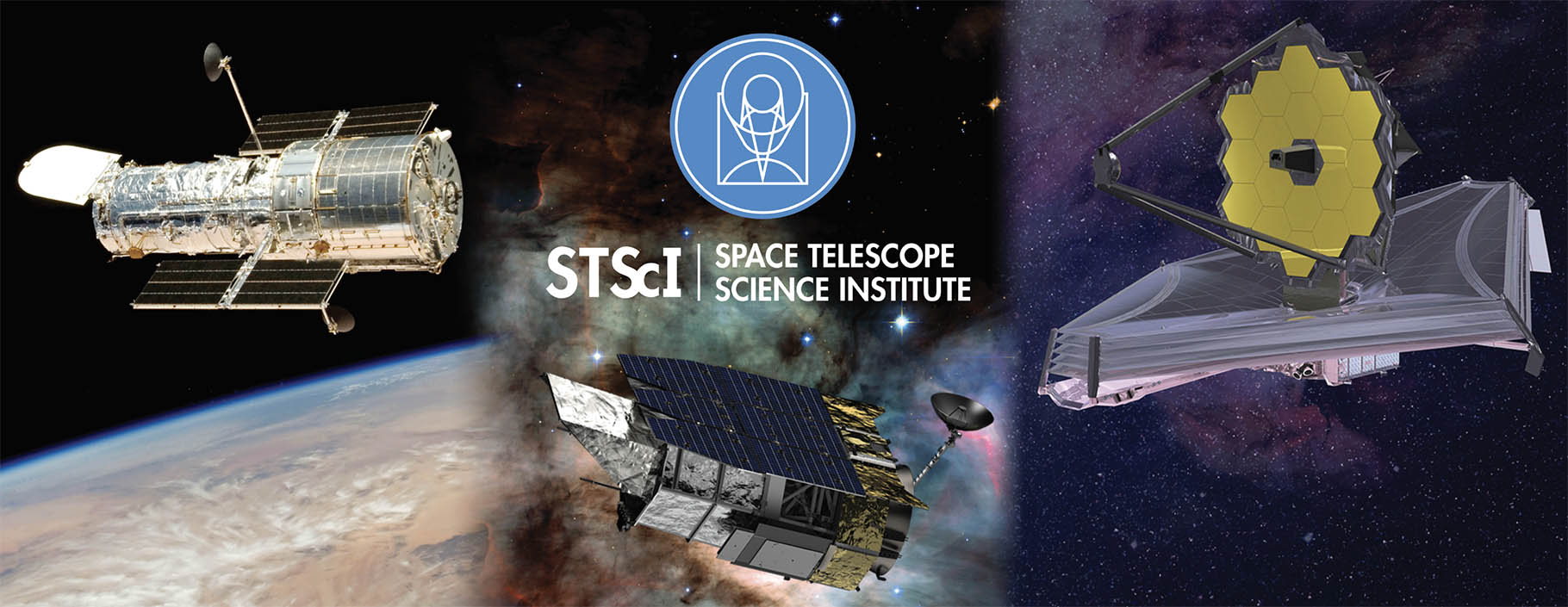
Space Telescope Science Institute (STScI) is a multi-mission operations center for NASA’s flagship observatories and a world-class astronomical research center. Operated by AURA for NASA, STScI has helped guide the most famous observatory in history, the Hubble Space Telescope.
Since the launch of the Hubble Space Telescope in 1990, STScI has performed its science operations. Today, Hubble continues to revolutionize astronomy and expand our knowledge of the Universe and has accounted for 1.6% of the world’s scientific return across all science fields since 1990.
STScI also leads the science and mission operations for the James Webb Space Telescope (JWST), which launched on December 25, 2021. The JWST Mission Operations Center, which sends commands for the observatory to execute, monitors its operational health, and receives scientific data on a daily basis is hosted at STScI.
The selection of the scientific programs for both JWST and Hubble is coordinated by STScI. Every year during science operations, the world-wide community of scientists are invited to submit observing proposals. STScI is also responsible for optimizing and characterizing the performance of Hubble’s and JWST’s science instruments.
STScI is also the science operations center for the Nancy Grace Roman Space Telescope, in development for launch in late 2026, and is a partner on several other NASA missions.
Staff at STScI conducts world-class scientific research; the Barbara A. Mikulski Archive for Space Telescopes (MAST) curates and disseminates data from over 20 astronomical missions; and STScI brings science to the world through internationally recognized news, education, and public outreach programs.
Looking forward, STScI is working on the Habitable Worlds Observatory, NASA’s next flagship observatory for the 2030s. Habitable Worlds Observatory is envisioned as a true “super Hubble” to not only tackle one of humanity’s oldest questions — Are we alone? — but also to also pursue enduring and emerging questions across all of astrophysics and cosmic origins, from cosmology to the life cycles of galaxies, stars, and planets.
NASA’s James Webb Space Telescope finds the most distant known galaxy to date – only two hundred and ninety million years after the big bang.
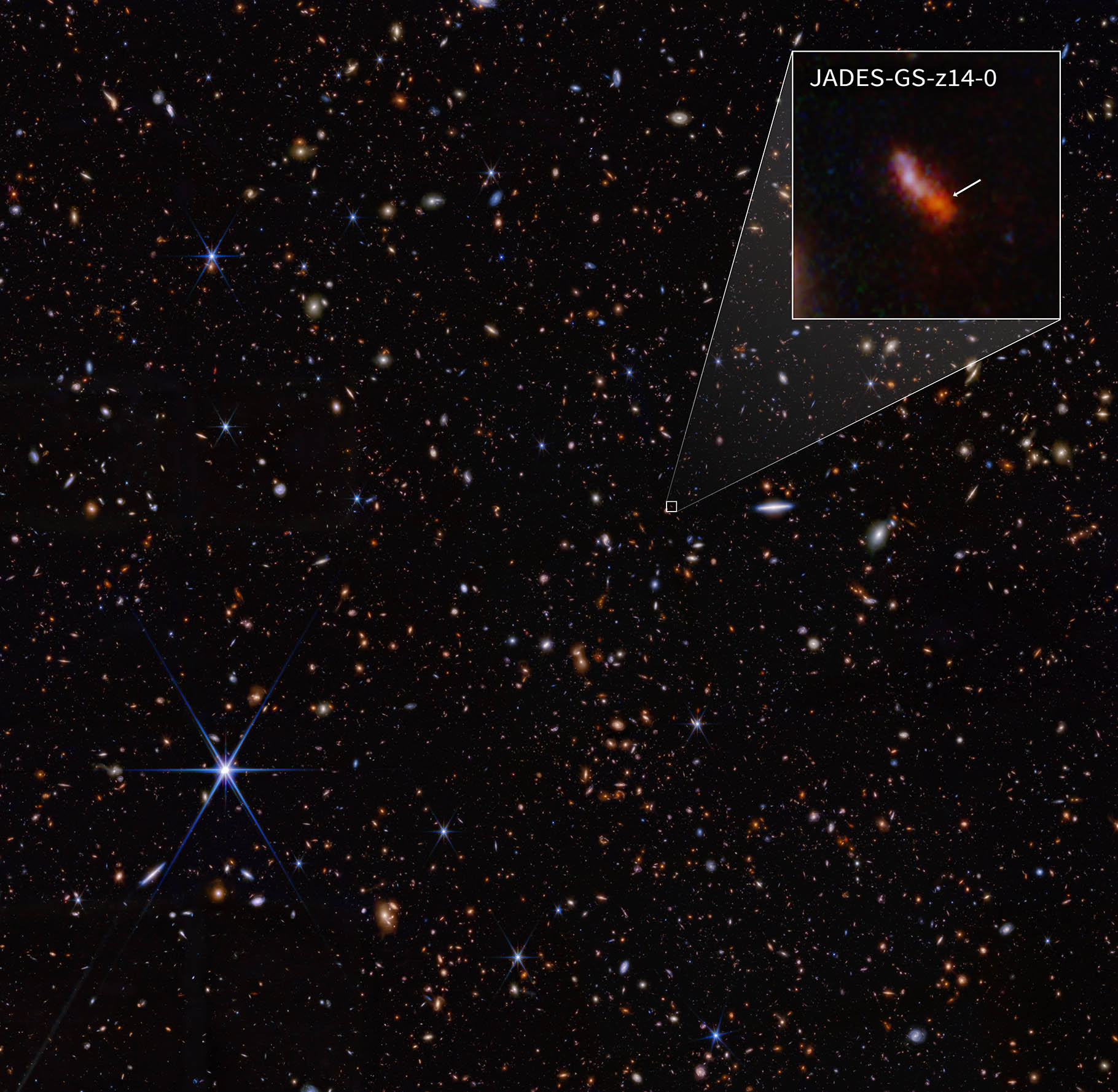
Over the last two years, scientists have used NASA’s James Webb Space Telescope to explore what astronomers refer to as Cosmic Dawn – the period in the first few hundred million years after the big bang where the first galaxies were born. These galaxies provide vital insight into the ways in which the gas, stars, and black holes were changing when the universe was very young. In October 2023 and January 2024, an international team of astronomers used Webb to observe galaxies as part of the JWST Advanced Deep Extragalactic Survey (JADES) program. Using Webb’s NIRSpec (Near-Infrared Spectrograph), they obtained a spectrum of a record-breaking galaxy observed only two hundred and ninety million years after the big bang. This corresponds to a redshift of about 14, which is a measure of how much a galaxy’s light is stretched by the expansion of the universe.
Note: This is data from Webb science in progress, which has not yet been through the peer-review process.