
NSF National Solar Observatory
The NSF National Solar Observatory (NSO) operates the world’s most extensive collection of ground-based optical and infrared solar telescopes and auxiliary instrumentation, allowing solar physicists to probe all aspects of the Sun.
The U.S. National Science Foundation (NSF) National Solar Observatory (NSO) supports facilities that provide forefront observational opportunities for the solar research community, and leads the operation of the Daniel K. Inouye Solar Telescope on Maui in Hawai‘i, built by the NSO and completed in 2021.
The Inouye Solar Telescope, a collaboration of 22 institutions, is the largest and most advanced solar telescope in the world, with unprecedented abilities to view details of the Sun. Using adaptive optics technology and a 4-meter telescope, Inouye explores physical processes that link the Sun to the Earth, and will set the stage to develop enhanced predictive capabilities of explosive solar events that drive geomagnetic storms. Inouye also furthers our understanding of other stars by allowing scientists to study fundamental physical processes that occur on their surfaces.
NSO also operates the Synoptic Optical Long-term Investigations of the Sun (SOLIS) and the Global Oscillation Network Group (GONG). SOLIS observes the Sun over decades to understand the solar activity cycle, solar irradiance changes, and energy releases in the solar atmosphere. GONG is a six-station network of extremely sensitive solar imagers located around Earth. GONG provides continuous imaging of the Sun and its solar magnetic field, and has been identified as a crucial asset for space weather operational forecasting.
AURA operates NSO under a cooperative agreement with NSF.
The NSF Daniel K. Inouye Solar Telescope captured the sharpest-ever images of a solar flare, revealing dark coronal loop strands in unprecedented detail.
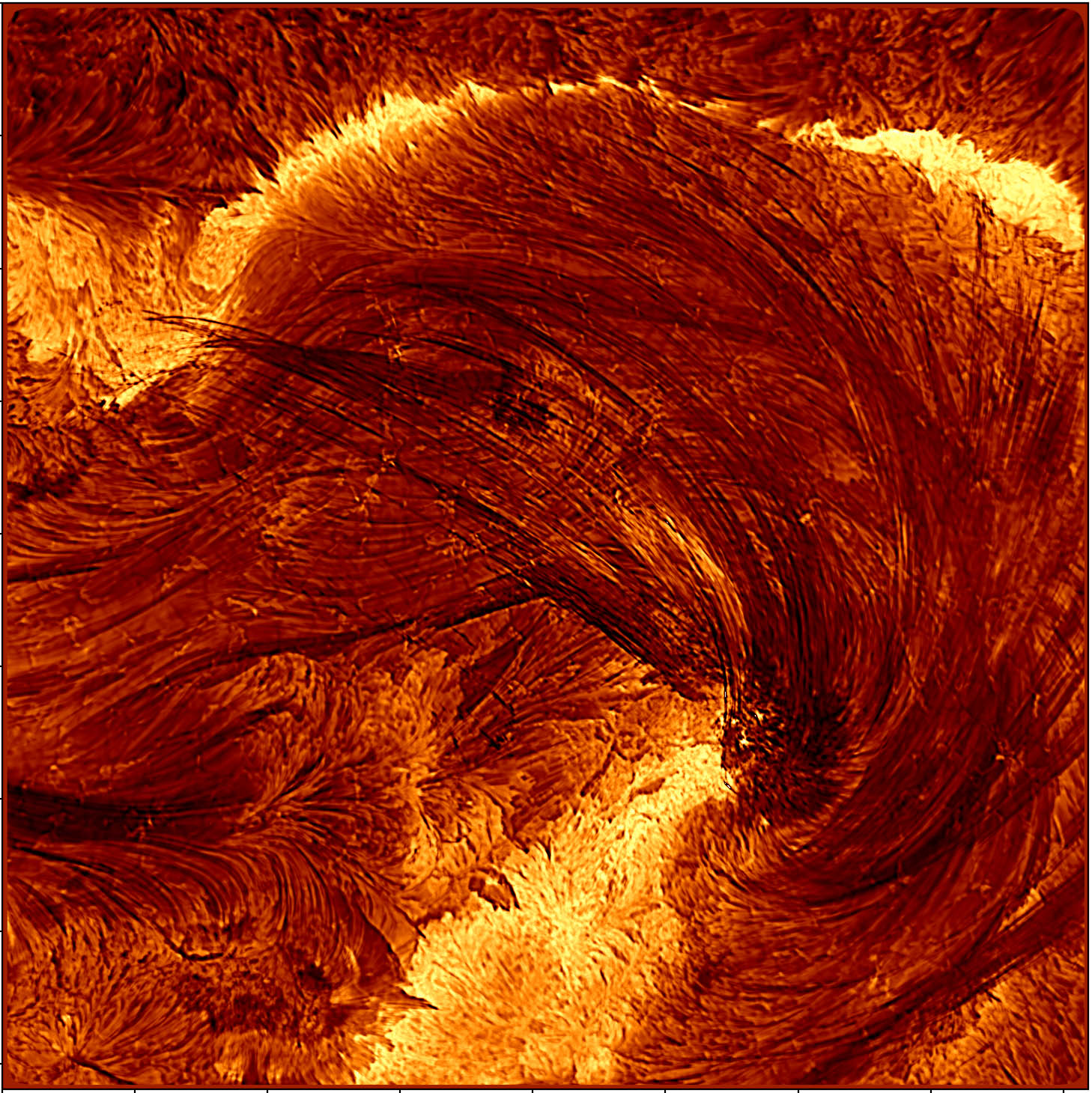
The highest-resolution images of a solar flare ever captured at the H-alpha wavelength (656.28 nm) may reshape how we understand the Sun’s magnetic architecture—and improve space weather forecasting. Using the U.S. National Science Foundation (NSF) Daniel K. Inouye Solar Telescope, astronomers captured dark coronal loop strands with unprecedented clarity during the decay phase of an X1.3-class flare on August 8, 2024, at 20:12 UT. The loops averaged 48.2 km in width—perhaps as thin as 21 km—the smallest coronal loops ever imaged. This marks a potential breakthrough in resolving the fundamental scale of solar coronal loops and pushing the limits of flare modeling into an entirely new realm.
Coronal loops are arches of plasma that follow the Sun’s magnetic field lines, often preceding solar flares that trigger sudden releases of energy associated with some of these magnetic field lines twisting and snapping. This burst of energy fuels solar storms that can impact Earth’s critical infrastructure. Astronomers at the Inouye observe sunlight at the H-alpha wavelength (656.28 nm) to view specific features of the Sun, revealing details not visible in other types of solar observations.
By improving researchers’ ability to model solar flares, these observations will also improve forecasting for space weather events that are hazardous to satellites, power grids, and communications on Earth.