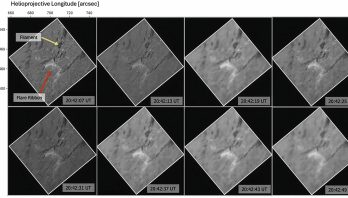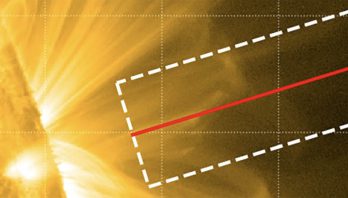

Close up of the Sun with a dotted rectangular white box over the a part of the outer portion. There is a red line through the white box lengthwise.

Uncovering the Waves That Power the Sun’s Outer Atmosphere

Observations from the U.S. National Science Foundation (NSF) Daniel K. Inouye Solar Telescope—built and managed by the NSF National Solar ...
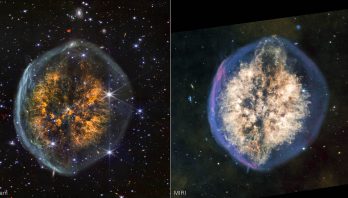
Side-by-side images of the same nebula show how differently it appears in near-infrared, on the left, versus mid-infrared light, on the right. Left image is labeled NIRCam and the right is labeled MIRI. In near-infrared, the nebula’s outer bubble has a white edge and its inner clouds are orange, with a distinct dark lane cutting vertically through the center. Stars and background galaxies appear around the nebula and through the outer bubble. In mid-infrared, the outer bubble has a bluish tint and there is more material in the inner clouds, which are colored off-white. The vertical dark lane is still present but more interrupted and covered by the clouds. Material appears to be erupting out the top of the nebula, and this effect is mirrored to a lesser degree at the bottom, opposite end.

NASA’s Webb Examines Cranium Nebula

Two heads are better than one in the latest images from NASA’s James Webb Space Telescope, which reveal new detail ...
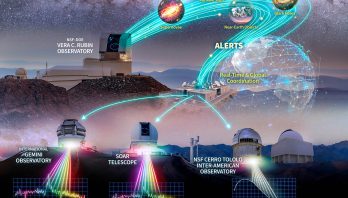
This artist’s illustration represents the start of the alert stream from NSF–DOE Vera C. Rubin Observatory. The summit facility is shown on a rocky ridge. The night sky features stars and the glittering band of the Milky Way Galaxy. The sky is populated with multiple alert “pings,” representing individual alerts from Rubin that something in the sky has changed in brightness or position. Different icons represent various types of alerts, including asteroids, supernovae, active galactic nuclei, and variable stars.

NSF–DOE Vera C. Rubin Observatory Launches Real-Time Discovery Machine for Monitoring the Night Sky

NSF–DOE Rubin Observatory has issued its first scientific alerts, marking a historic milestone in astrophysics. Expected to increase to seven ...
In the image center, an opaque oval cloud of gray gas aligned from 1 o’clock to 7 o’clock hides a star. Two strong beams of light from the star emerge from large holes in both sides of the cloud, forming narrow cones extending toward 10 o’clock and 4 o’clock. The central cloud is surrounded by concentric, wispy shells of gas illuminated by the star’s light. The shells reflect extra light where they’re hit by the twin beams. A crowd of smaller stars with cross-shaped spikes over them surrounds the nebula on a black background.

NASA’s Hubble Captures Light Show Around Rapidly Dying Star

This stunning image from NASA’s Hubble Space Telescope reveals a dramatic interplay of light and shadow in the Egg Nebula, sculpted by ...
A wide field of view showing deep space, dotted with many small galaxies and a few foreground stars that display six diffraction spikes. One galaxy is highlighted with a magnified image in a graphic pull-out box in the lower right corner. The galaxy is labeled MoM-z14 and appears as a blurry yellow blob with a small red area at its top.

NASA Webb Pushes Boundaries of Observable Universe Closer to Big Bang

NASA’s James Webb Space Telescope has topped itself once again, delivering on its promise to push the boundaries of the ...
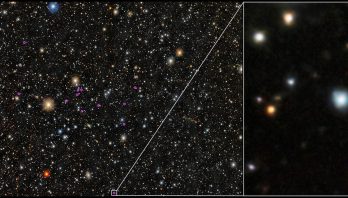
A black background is filled with stars -small and large glowing white, red, yellow and blue.

Dark Energy Survey Scientists Release Analysis of All Six Years of Survey Data

The Dark Energy Survey Collaboration collected information on hundreds of millions of galaxies across the Universe using the U.S. Department ...
Artist illustration of a yellow star with rungs around it. to the tight of the star is a orange cloud.

Massive Cloud With Metallic Winds Discovered Orbiting Mystery Object

Astronomers using the Gemini South telescope achieve unprecedented detection of vaporized metals within a dusty, gaseous cloud during rare stellar ...
This artist’s illustration depicts 2025 MN45 — the fastest-rotating asteroid with a diameter over 500 meters that scientists have ever found. The asteroid is shown surrounded by many other asteroids, depicting its location within the main asteroid belt. The Sun and Jupiter are shown in the distance. 2025 MN45 is 710 meters (0.44 miles) in diameter, and it completes a full rotation every 1.88 minutes. The discovery was made using data from NSF–DOE Vera C. Rubin Observatory, jointly funded by the U.S. National Science Foundation and the U.S. Department of Energy's Office of Science.

NSF–DOE Vera C. Rubin Observatory Spots Record-Breaking Asteroid in Pre-Survey Observations

First peer-reviewed paper using LSST Camera data identifies an asteroid, nearly the size of eight football fields, rotating every two ...
A region of space mostly filled with background galaxies, with one prominent star at upper left. A large blob of purple haze occupies much of the field. Within the purple region, an unremarkable area is outlined with a dashed white circle.

NASA’s Hubble Examines Cloud-9, First of New Type of Object

A team using NASA’s Hubble Space Telescope has uncovered a new type of astronomical object — a starless, gas-rich, dark-matter cloud considered a “relic” ...
Image labeled Fomalhaut system, Hubble Space Telescope. A grainy orange oval ring tilts slightly from upper right to lower left. At two o'clock, a white box outlines the ring's edge and white lines extend to a larger pullout box at lower right. Two spots inside the larger box are marked with dashed white circles and labeled cs1 2012 and cs2 2023. Inside the ring is a black circle with a white star symbol in the middle.

NASA’s Hubble Sees Asteroids Colliding at Nearby Star for First Time

Like a game of cosmic bumper cars, scientists think the early days of our solar system were a time of ...
Bright reds, yellows and orange points of lights are scattered on a black background Some are obviously galaxies with small pinwheel shape and others are just points of light. In the Center is a bright blue glowing object next to a fainter orange one.

Bright Blue Cosmic Outbursts Likely Caused by Large Black Holes Shredding Massive Companions

In 2024, astronomers discovered the brightest Luminous Fast Blue Optical Transient (LFBOT) ever observed. LFBOTs are extremely bright flashes of ...
llustration labeled “artist’s concept” at right bottom corner. At left bottom corner, a partially illuminated, lemon-shaped exoplanet appears against a black background. This planet is most brightly illuminated at its elongated tip on its right side. On the left side, which is wider, the planet trails off into the darkness of the background. The planet is colored in varying, mottled shades of red, light pink, and fuchsia. Most of the pink occurs closest to the tip, while most of the fuchsia is at the top and bottom edges. At right top corner, a white beam emanates diagonally, oriented from 10 o’clock to 4 o’clock, from either side of a small, glowing, white star.

NASA’s Webb Observes Exoplanet Whose Composition Defies Explanation

Scientists using NASA’s James Webb Space Telescope have observed a rare type of exoplanet, or planet outside our solar system, whose ...