
New Solar Flare Observations Challenge Leading Theories
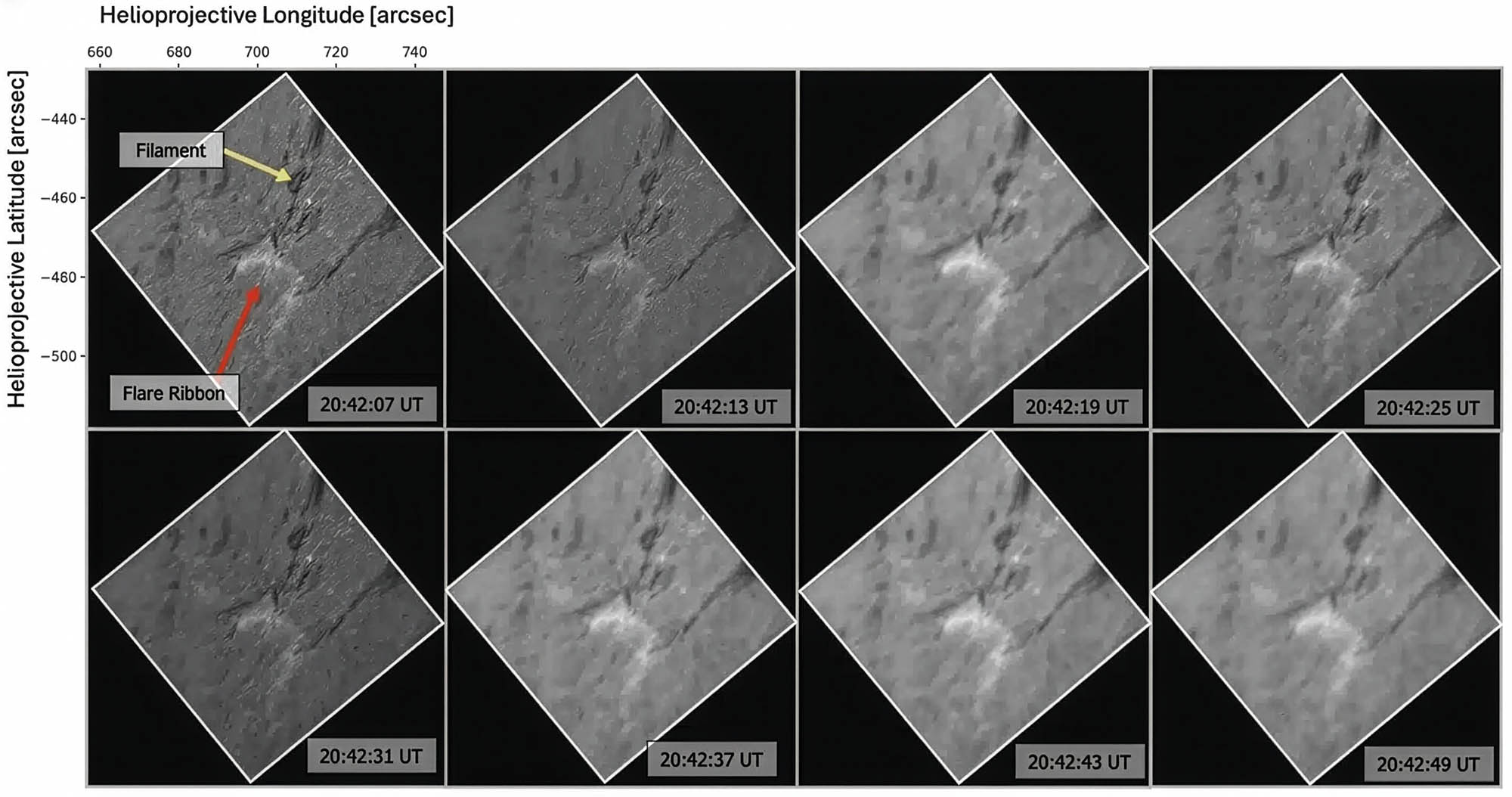
Using the NSF Daniel k. Inouye solar telescope, scientists captured highly detailed measurements of a fading solar flare. The findings reveal gaps in current models of how flares heat the sun’s lower atmosphere, pointing to the need for more comprehensive theories.
SUMMARY: Astronomers have taken a novel look at a fading solar flare, capturing details never before seen with the world’s most powerful solar telescope, the U.S. National Science Foundation (NSF) Daniel K. Inouye Solar Telescope, built and managed by the NSF National Solar Observatory (NSF NSO) in Hawai‘i. Using its Visible Spectropolarimeter (ViSP) instrument, researchers observed a moderate C6.7-class flare on August 19, 2022, recording extremely sharp measurements of two specific fingerprints of light from the Sun’s lower atmosphere. These signals, known as the Calcium II H and Hydrogen-epsilon lines—two strong fingerprints of solar activity in the solar spectrum—have rarely been studied together in modern high-resolution flare research, and never at the Inouye’s extraordinary level of detail. When scientists compared the observations with leading computer models that simulate how flares are heated—either by beams of high-energy particles or by heat spreading through the solar atmosphere—they found that the models could reproduce some features, but failed to fully explain others. In particular, the observed light signatures were broader and differed in brightness in ways the simulations could not match. The findings suggest that current theories do not yet fully capture the complex physics unfolding in the Sun’s lower atmosphere during a flare’s decline. The NSO researchers behind the study say improving these models will require rethinking how flare heating works and testing ideas against similarly detailed observations of both the explosive and cooling phases of solar eruptions.
When a solar flare erupts, scientists rely on specific “fingerprints” of light, known as spectral lines, to understand the intense physics playing out in the Sun’s atmosphere.
For decades, the Calcium II H and Hydrogen-epsilon spectral lines have been of interest to researchers studying both solar and stellar flares. Sitting close together in the solar spectrum, these lines provide a window into the chromosphere, the complex layer of the solar atmosphere between the visible surface (photosphere) and corona (outer atmosphere).
While past observations of this specific spectral window have been bottlenecked by the cadence, spatial resolution, or spectral resolution limits of older telescopes, the U.S. National Science Foundation (NSF) Daniel K. Inouye Solar Telescope, built and managed by the NSF National Solar Observatory (NSO) on Maui, aims to change that. With its superior capabilities in all three of these regimes, the Inouye reached a milestone in 2022 by providing a modern, high-resolution look at this spectral window that has long evaded solar observatories.
The findings from this observation are explored in a newly published study led by Cole Tamburri and a large team of NSO co-authors.
Surprises in the Decay Phase
The observation, captured by the Inouye on August 19, 2022, targeted a moderate C6.7-class flare. Flares are classified A, B, C, M, and X with each letter class representing a 10-fold increase in energy, with a 1-9 scale within—i.e., from A, which is barely above background levels, to X, which could cause worldwide radio blackouts and long-lasting radiation storms. The team initially aimed to capture the early, explosive phase of the event, but instead caught its decay phase, the period when the impulsive, chaotic behavior of the solar flare is supposed to have mostly ended.
Yet, the Inouye’s observing sequence revealed something unexpected. The data showed highly asymmetric spectral line shapes across different parts of the flare ribbon (bright, ribbon-like structure that marks the “footprint” of the flare). This discovery suggests that the flare’s emission remains highly non-uniform and physically complex, even as the flare cools and decays.
Testing the State-of-the-Art
The true test of new observational data is how it aligns with theoretical physics. For the first time, researchers compared the Inouye’s flare observations directly to simulations run on RADYN, a state-of-the-art computational model used to simulate how flares heat the solar atmosphere.
The comparison yielded a fascinating mix of agreements and discrepancies:
- The Agreements: The physical models proved remarkably accurate in certain areas, particularly when simulating the width of the hydrogen-epsilon line. This confirms that the physics driving the RADYN code are on the right track when compared to high-resolution observations.
- The Discrepancies: The models struggled to match the observed Calcium II H line shape. The real-world light signatures behaved in ways the simulations could not yet replicate, highlighting significant gaps in our current understanding.