
Early Data from NSF–DOE Vera C. Rubin Observatory Reveals Over 11,000 New Asteroids
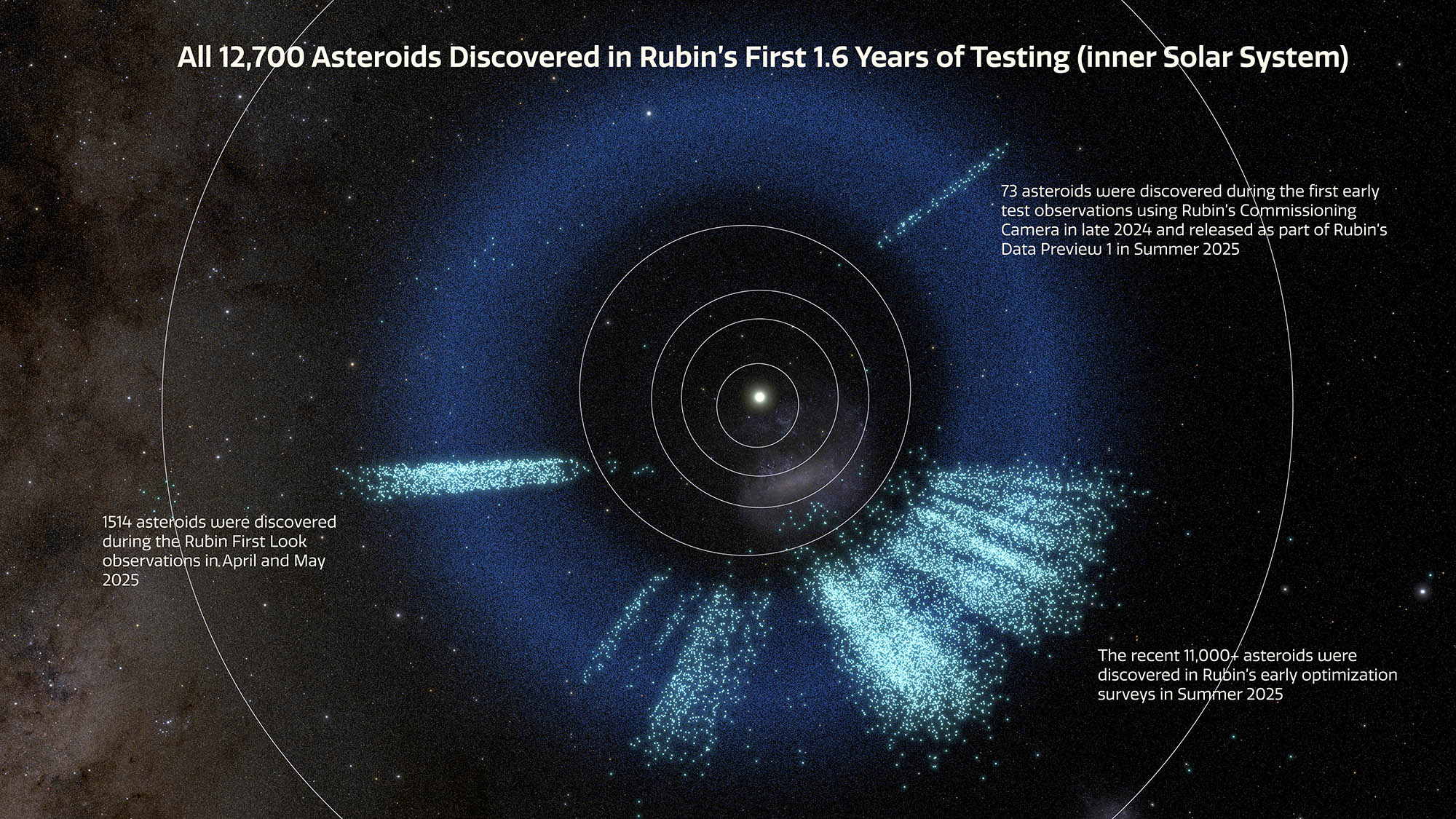
Rubin’s largest asteroid haul yet, gathered before the Legacy Survey of Space and Time even begins, is just the “tip of the iceberg”
Scientists at NSF–DOE Vera C. Rubin Observatory, jointly funded by the U.S. National Science Foundation and the U.S. Department of Energy’s Office of Science, have submitted an unprecedented set of asteroid detections to the IAU Minor Planet Center, including hundreds of distant worlds beyond Neptune and 33 previously unknown near-Earth asteroids.
Using preliminary data from NSF–DOE Vera C. Rubin Observatory, scientists have discovered over 11,000 new asteroids [1]. The data were confirmed by the International Astronomical Union’s Minor Planet Center (MPC), making this the largest single batch of asteroid discoveries submitted in the past year. The discoveries were made using data from Rubin’s early optimization surveys and offer a powerful preview of the observatory’s transformative impact on Solar System science.
Rubin Observatory is a joint program of NSF NOIRLab and DOE’s SLAC National Accelerator Laboratory, who cooperatively operate Rubin. NOIRLab is managed by the Association of Universities for Research in Astronomy (AURA).
The submission to MPC comprises approximately one million observations, taken over the span of a month and a half, of over 11,000 new asteroids and more than 80,000 already known asteroids, including some that had previously been observed but were later “lost” because their orbits were too uncertain to predict their future locations. You can interact with all of Rubin’s asteroid discoveries in the Rubin Orbitviewer, which uses real data to provide an intuitive way to explore the structure of our cosmic backyard in three dimensions and in real time. Also, visit the Rubin Asteroid Discoveries Dashboard to learn about the new objects Rubin has uncovered.
“This first large submission after Rubin First Look is just the tip of the iceberg and shows that the observatory is ready,” says Mario Juric, faculty at the University of Washington and Rubin Solar System Lead Scientist. “What used to take years or decades to discover, Rubin will unearth in months. We are beginning to deliver on Rubin’s promise to fundamentally reshape our inventory of the Solar System and open the door to discoveries we haven’t yet imagined.”
Among the newly identified objects are 33 previously unknown near-Earth objects (NEOs), which are small asteroids and comets whose closest approach to the Sun is less than 1.3 times the distance between Earth and the Sun. None of the newly discovered NEOs pose a threat to Earth, and the largest is about 500 meters wide. Objects larger than 140 meters are closely tracked as they could cause significant regional damage if they impact, yet scientists estimate that only about 40% of these mid-sized NEOs have been identified so far.
Once operating fully in survey mode, Rubin is expected to reveal an additional nearly 90,000 new NEOs, some of which may be potentially hazardous, and to nearly double the number of known NEOs larger than 140 meters to around 70%. By enabling early detection and continuous monitoring of these objects, Rubin will be a powerful tool for planetary defense.