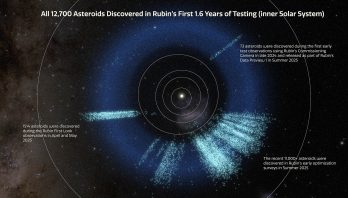

A rendering of the inner Solar System showing the asteroids discovered by Rubin in light teal. Known asteroids are dark blue. The rendering shows a total of almost 12,700 asteroids that were discovered with Rubin over the span of 1.6 years: 73 were discovered during the first early test observations using Rubin’s Commissioning Camera in late 2024 and released as part of Rubin’s Data Preview 1 in Summer 2025; 1514 were discovered during First Look observations in April and May 2025; and the recent 11,000+ asteroids were discovered using observations taken during Rubin’s early optimization surveys in Summer 2025. These are the locations of objects at the time of each object’s discovery. In the time since discovery, the objects have continued in their orbits around the Sun and dispersed from the narrow “pencil beam” rays seen in this graphic. See this in the animation of the model here

Early Data from NSF–DOE Vera C. Rubin Observatory Reveals Over 11,000 New Asteroids

Scientists at NSF–DOE Vera C. Rubin Observatory, jointly funded by the U.S. National Science Foundation and the U.S. Department of ...
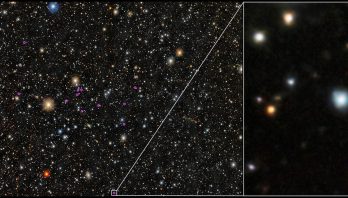
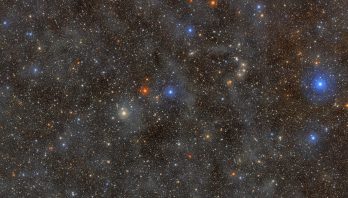
This image shows Star PicII-503 in Pictor II ultra-faint dwarf galaxy. The right side is a pullout from the very starry field on the left. In the middle of the pullout on the right is a blurry white light that is Picll-503

Extremely Rare Second-Generation Star Discovered Inside Ancient Relic Dwarf Galaxy

Astronomers have discovered one of the most chemically primitive stars ever identified — an ancient stellar relic that preserves the ...
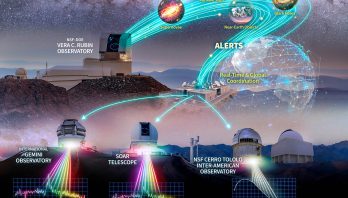
An illustration of NSF NOIRLab's follow-up ecosystem. The telescopes pictured are connected by blue beams of light. The telescopes on the bottom have rainbow beam coming from them representing their observations.

First NSF NOIRLab Follow-Up Observations Triggered by NSF–DOE Rubin Alerts

NSF NOIRLab, funded by the U.S. National Science Foundation, has completed end-to-end runs of its ecosystem for following up on ...
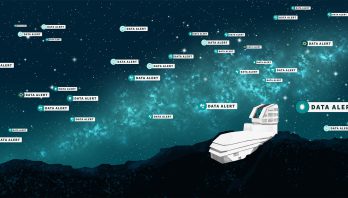
This artist’s illustration represents the start of the alert stream from NSF–DOE Vera C. Rubin Observatory. The summit facility is shown on a rocky ridge. The night sky features stars and the glittering band of the Milky Way Galaxy. The sky is populated with multiple alert “pings,” representing individual alerts from Rubin that something in the sky has changed in brightness or position. Different icons represent various types of alerts, including asteroids, supernovae, active galactic nuclei, and variable stars.

NSF–DOE Vera C. Rubin Observatory Launches Real-Time Discovery Machine for Monitoring the Night Sky

NSF–DOE Rubin Observatory has issued its first scientific alerts, marking a historic milestone in astrophysics. Expected to increase to seven ...
A black background is filled with stars -small and large glowing white, red, yellow and blue.

Dark Energy Survey Scientists Release Analysis of All Six Years of Survey Data

The Dark Energy Survey Collaboration collected information on hundreds of millions of galaxies across the Universe using the U.S. Department ...
Artist illustration of a yellow star with rungs around it. to the tight of the star is a orange cloud.

Massive Cloud With Metallic Winds Discovered Orbiting Mystery Object

Astronomers using the Gemini South telescope achieve unprecedented detection of vaporized metals within a dusty, gaseous cloud during rare stellar ...
This artist’s illustration depicts 2025 MN45 — the fastest-rotating asteroid with a diameter over 500 meters that scientists have ever found. The asteroid is shown surrounded by many other asteroids, depicting its location within the main asteroid belt. The Sun and Jupiter are shown in the distance. 2025 MN45 is 710 meters (0.44 miles) in diameter, and it completes a full rotation every 1.88 minutes. The discovery was made using data from NSF–DOE Vera C. Rubin Observatory, jointly funded by the U.S. National Science Foundation and the U.S. Department of Energy's Office of Science.

NSF–DOE Vera C. Rubin Observatory Spots Record-Breaking Asteroid in Pre-Survey Observations

First peer-reviewed paper using LSST Camera data identifies an asteroid, nearly the size of eight football fields, rotating every two ...
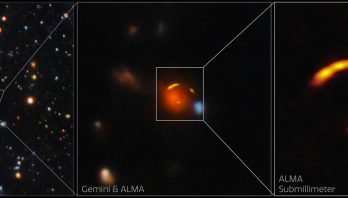
Bright reds, yellows and orange points of lights are scattered on a black background Some are obviously galaxies with small pinwheel shape and others are just points of light. In the Center is a bright blue glowing object next to a fainter orange one.

Bright Blue Cosmic Outbursts Likely Caused by Large Black Holes Shredding Massive Companions

In 2024, astronomers discovered the brightest Luminous Fast Blue Optical Transient (LFBOT) ever observed. LFBOTs are extremely bright flashes of ...
a bright light is in the center of the image is surrounded by a greenish glow on a dark black background.

Gemini North Color Images Reveal Greenish Glow of Comet 3I/ATLAS

Gemini North captured new images of Comet 3I/ATLAS after it reemerged from behind the Sun on its path out of ...
Gemini South Celebrates 25th Anniversary With Stunning Snapshot of the Butterfly Nebula

Gemini South Celebrates 25th Anniversary With Stunning Snapshot of the Butterfly Nebula

To celebrate 25 years since the completion of the International Gemini Observatory, students in Chile voted for the Gemini South ...
Ua ʻŌhiʻa Lani: An Image to Celebrate Gemini North’s 25th Anniversary features a red-orange background dotted by stars. Tall dark pillars of gas and dust rise in the foreground.

Students in Hawai‘i Name Mesmerizing Image Ua ʻŌhiʻa Lani for the International Gemini Observatory’s 25th Anniversary

To celebrate 25 years since the completion of the International Gemini Observatory, students in Hawai‘i voted for the Gemini North ...
Slightly curved thin luminous lines from purple to turquoise to green to red and then yellow, run vertically over on a black background.

New Instrument at SOAR Achieves First Light with Observations of Remarkable Binary Star System

The SOAR Telescope, located on Cerro Pachón in Chile, has received a major upgrade with the installation of the SOAR ...