
NSF–DOE Vera C. Rubin Observatory Launches Real-Time Discovery Machine for Monitoring the Night Sky
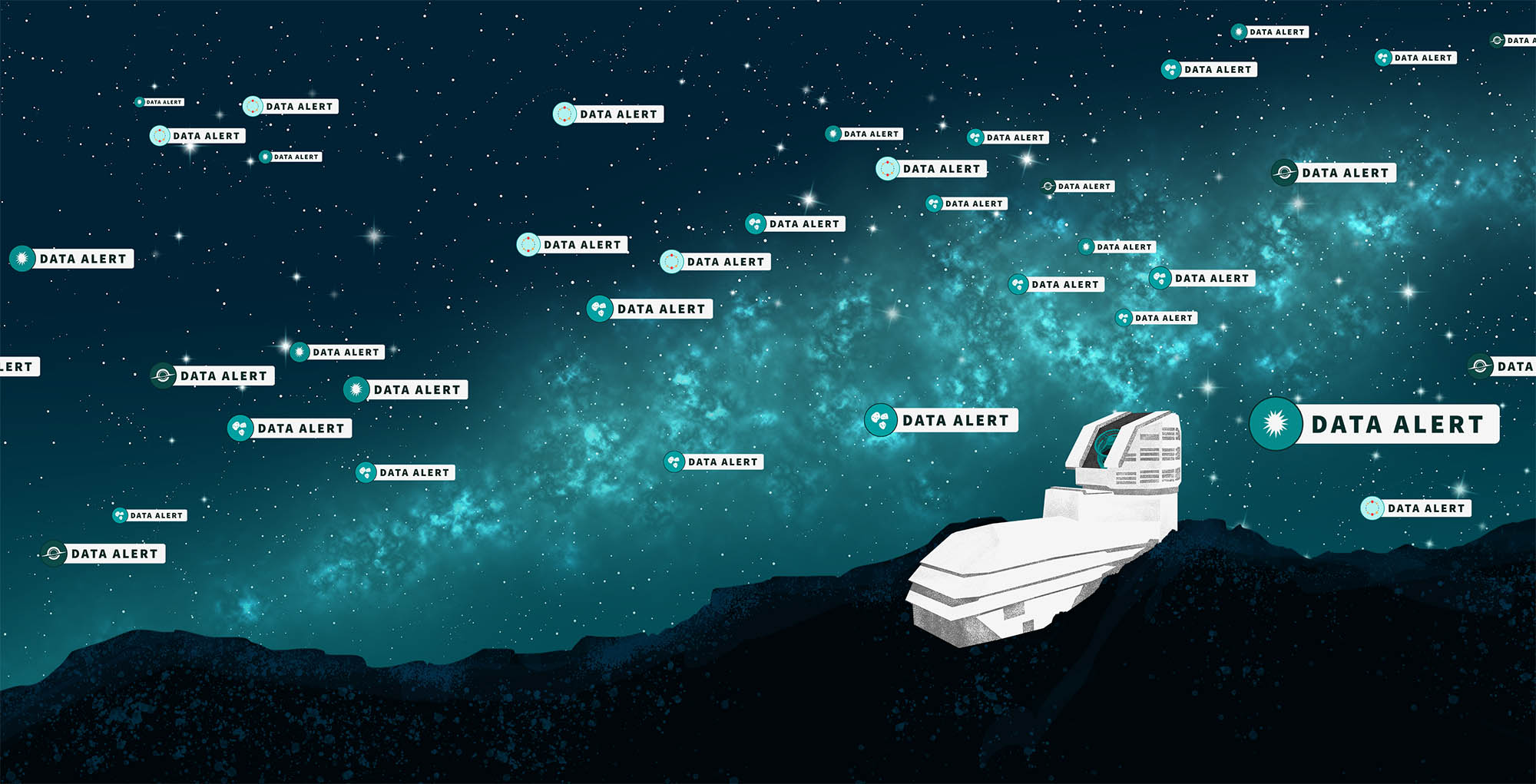
The near-real-time alert system will enable scientists around the world to coordinate follow-up observations like never before
NSF–DOE Rubin Observatory has issued its first scientific alerts, marking a historic milestone in astrophysics. Expected to increase to seven million alerts per night, these first alerts start a new era of dynamic, real-time observation of the night sky.
NSF–DOE Vera C. Rubin Observatory, jointly funded by the U.S. National Science Foundation (NSF) and the U.S. Department of Energy’s Office of Science (DOE/SC), has released its first alerts documenting astronomical events spotted by the observatory. Rubin issued 800,000 alerts the night of 24 February. These alerts called scientists’ attention to new asteroids, exploding stars, and other changes in the night sky. This milestone marks the launch of a system expected to eventually produce up to seven million alerts per night.
Among the first alerts are detections of supernovae, variable stars, active galactic nuclei, and objects whizzing around our Solar System, such as asteroids. The beginning of scientific alerts is one of the last major milestones before Rubin Observatory begins its Legacy Survey of Space and Time (LSST) later this year. During the LSST, Rubin will scan the Southern Hemisphere sky nightly for ten years to precisely capture every visible change using the largest digital camera ever made. These alerts will chronicle the treasure trove of scientific discoveries that Rubin will make through its time-lapse record of the Universe. In the first year of the LSST, Rubin is expected to capture images of more objects than all other optical observatories combined in human history.
“By connecting scientists to a vast and continuous stream of information, NSF–DOE Rubin Observatory will make it possible to follow the Universe’s events as they unfold, from the explosive to the most faint and fleeting,” says Luca Rizzi, a program director for research infrastructure at NSF.
“The discoveries reported in these alerts reflect the power of NSF–DOE Rubin Observatory as a tool for astrophysics and the importance of sustained federal support,”says Kathy Turner, program manager in the High Energy Physics program in the DOE’s Office of Science. “Rubin Observatory’s groundbreaking capabilities are revealing untold astrophysical treasures and expanding scientists’ access to the ever-changing cosmos.”
Rubin’s alerts will power discoveries in many areas of astronomy, astrophysics, and cosmology. While the night sky seems calm and unchanging to the casual viewer, it’s actually alive with motion and transformation. Each alert signals something that has changed in the sky since Rubin last looked — a new source of light, a star that brightened or dimmed, or an object that moved. With Rubin’s alerts, scientists will have a greater ability to catch supernovae in their earliest moments, discover and track asteroids to assess potential threats to Earth, and spot rare interstellar objects as they race through the Solar System. Scientists can then use these data to better understand the nature of dark matter, dark energy, and other unknown aspects of the Universe.
“Rubin’s alert system was designed to allow anyone to identify interesting astronomical events with enough notice to rapidly obtain time-critical follow-up observations,” says Eric Bellm, Alert Production Pipeline Group Lead for Rubin Data Management from NSF NOIRLab and the University of Washington. “Enabling real-time discovery on 10 terabytes of images nightly has required years of technical innovation in image processing algorithms, databases, and data orchestration. We can’t wait to see the exciting science that comes from these data.”
The near-real-time public nature of Rubin’s alert system enables scientists using other ground and space-based telescopes around the world to coordinate follow-up observations like never before. This collaboration will enable fast and detailed studies of unfolding phenomena.
The first Rubin Observatory alerts distributed to researchers worldwide were generated on the night of 24 February. The alerts contained the flares of new supernovae and the flickers of stars, actively feeding black holes in distant galaxies, and asteroids cruising through our Solar System.