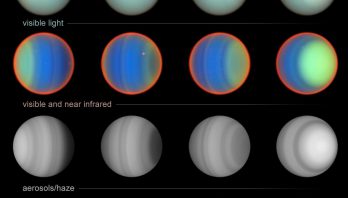

Graphic titled “Hubble Space Telescope – Observations of Uranus,” with 16 images of Uranus, arranged in a 4 by 4 grid showing changes in appearance of Uranus as observed by Hubble between 2002 and 2022. Columns are labeled with observation year, from left to right: 2002; 2012; 2015; and 2022. Rows are labeled from top to bottom: visible light; visible and near infrared; aerosols/haze; and methane depletion. In the visible light images in the top row, Uranus appears blue-green with faint vertical bends of slightly lighter or darker color. In the visible and near infrared images in the second row, Uranus is very colorful, with deep neon blue to neon green bands within an orange-red glow that outlines the edge of the planet. In the two bottom rows of images, Uranus appears in grayscale, with vertical bands ranging from dark gray to almost white. All four rows of images show changes from observation to observation (left to right). For a given year, all four images in the column show similar banding patterns.

20-Year Hubble Study of Uranus Yields New Atmospheric Insights

The ice-giant planet Uranus, which travels around the Sun tipped on its side, is a weird and mysterious world. Now, ...
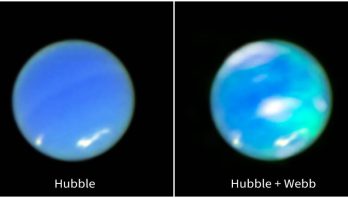
A two-panel horizontal image. On the left is Neptune, as seen from the Hubble Space Telescope. It is a blue circle, tilted about 25 degrees to the left. There are white smudges at 7 o’clock and just above 5 o’clock. At the right is an opposing view of the planet, using data from Hubble and Webb. It is a multi-hued blue orb. There are white smudges in the same spots as the image on the left, but also at the center of the planet and at the top. There are cyan smudges vertically along the right side, with the top of the smudging more translucent than the bottom.

NASA’s Webb Captures Neptune’s Auroras For First Time

For the first time, NASA’s James Webb Space Telescope has captured bright auroral activity on Neptune. Auroras occur when energetic ...
To blue and black speckled fans originate from the top and bottom of this image and meet in the middle.

Tantalizing Hints That Dark Energy is Evolving — New Results and Data Released by the DESI Project

The DESI collaboration has published a new analysis of dark energy using their first three years of collected data, which ...
Artist’s Illustration of a Sun from the viewpoint of a red planet.

Planetary System Found Around Nearest Single Star

Using in part the Gemini North telescope, one half of the International Gemini Observatory, partly funded by the U.S. National ...
Artist’s illustration of dwarf galaxy with active galactic nucleus

DESI Uncovers 300 New Intermediate-Mass Black Holes Plus 2500 New Active Black Holes in Dwarf Galaxies

Within the Dark Energy Spectroscopic Instrument’s early data, scientists have uncovered the largest samples ever of intermediate-mass black holes and ...
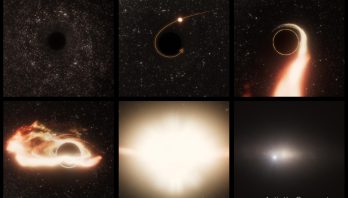
A large, black circle representing a black hole occupies the right third of the frame in this illustration. Thick, clumpy orange streaks arc above and below it, essentially surrounding it. The top arc extends down to the lower left and then curves around in front of the black hole to form a disk that is tilted toward the viewer. Near the inner edge of the disk, several bright, whiter spots have blue filaments looping above them, representing flares. The words “Artist’s Concept” appear in the bottom left corner in gray.

Webb Reveals Rapid-Fire Light Show From Milky Way’s Central Black Hole

The supermassive black hole at the center of the Milky Way appears to be having a party, complete with a ...
Artistic representation of the largest radio jet in the early Universe

Gemini North Teams Up With LOFAR to Reveal Largest Radio Jet Ever Seen in the Early Universe

From decades of astronomical observations scientists know that most galaxies contain massive black holes at their centers. The gas and ...
A large galaxy is at center, and a significantly smaller galaxy is to its left. The large galaxy, nicknamed the Bullseye, is mostly face-on, but the top appears slightly tilted away. It has several rings. Its circular core is bright white at the very center, but light yellow overall. Going outward, there are gaps between the rings. The core is surrounded by two slightly lighter yellow rings, which also appear to be overlapping. The next ring is slightly more transparent and yellow. The two or three rings that are farther out are bluer, sometimes with blue clumps. The widest ring is also blue, but also the most transparent. At 9 o’clock is a small dwarf galaxy. It is about the same size as the yellow core of the Bullseye. The dwarf galaxy is blue, with many dots. It looks like the edge of the Bullseye might touch the dwarf galaxy. Both galaxies are set on the black background of space, which is dotted with a range of galaxies in different shapes, colors, and sizes, along with one foreground star at left.

Straight Shot: Hubble Investigates Galaxy with Nine Rings

NASA's Hubble Space Telescope has captured a cosmic bullseye! The gargantuan galaxy LEDA 1313424 is rippling with nine star-filled rings ...
NASA's Hubble Traces Hidden History of Andromeda Galaxy

NASA’s Hubble Traces Hidden History of Andromeda Galaxy

In the years following the launch of NASA's Hubble Space Telescope, astronomers have tallied over 1 trillion galaxies in the ...
Three images side by side of ultra-faint dwarf galaxies that reside in a region of space isolated from the environmental influence of larger objects.

DECam and Gemini South Discover Three Tiny ‘Stellar-Ghost-Town’ Galaxies

By combining data from the DESI Legacy Imaging Surveys and the Gemini South telescope, astronomers have investigated three ultra-faint dwarf ...
A good comparison of the ComCam engineering test camera with the LSSTCam can be seen in the figure. The two have the same resolution and sensitivity, but the LSSTCam covers 21 times more area on the sky in every image. A single test engineering image from the very first night of the ComCam campaign, before any detailed tuning or more precise alignment of the optical system, is shown in the context of the coverage that will be provided by the LSSTCam: every one of the 21 squares in the teal wire frame is equivalent to another ComCam, all observing the sky at the same time. As ComCam already covers an impressive area equivalent to two full Moons, the promise of the full LSSTCam is incredible.

Testing, Testing! NSF–DOE Vera C. Rubin Observatory Completes Comprehensive System Tests With Flying Colors

After ten years of construction, NSF–DOE Vera C. Rubin Observatory is less than one year away from the start of its transformational ...
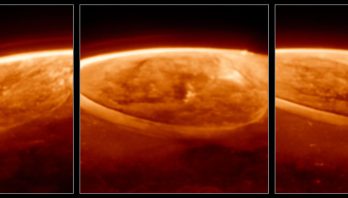
Three rows show Webb images of the same region taken on three different dates. The top row is labeled August 19, 2024. The middle row is labeled September 16, 2024. The bottom row is labeled September 30, 2024. Each row shows two images split by a vertical black bar where there is no data. Each image is speckled with dozens of white stars, some showing Webb’s signature 8-point diffraction spikes, against the black background of space. The images also show tightly packed, glowing red filaments that resemble muscle fibers or wood grain. While the background stars are the same in every row, the filaments change noticeably. In the top row, the filaments extend horizontally from upper left to lower right. In the middle and bottom rows, the filaments extend from lower left to upper right, and seem to shift slightly downward in position, with the last the lowest.

NASA’s Webb Reveals Intricate Layers of Interstellar Dust, Gas

Once upon a time, the core of a massive star collapsed, creating a shockwave that blasted outward, ripping the star ...