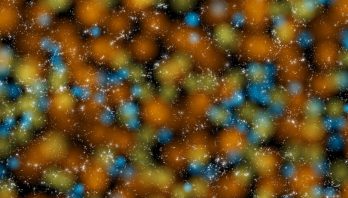

A scattering of white points, each representing a galaxy. Fuzzy circles colored orange, yellow-green, and blue show voids of various sizes where there are few galaxies.

NASA’s Roman Telescope Will Observe Thousands of Newfound Cosmic Voids

Our universe is filled with galaxies, in all directions as far as our instruments can see. Some researchers estimate that ...
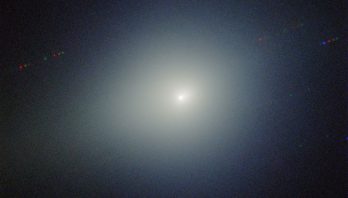
a bright light is in the center of the image is surrounded by a greenish glow on a dark black background.

Gemini North Color Images Reveal Greenish Glow of Comet 3I/ATLAS

Gemini North captured new images of Comet 3I/ATLAS after it reemerged from behind the Sun on its path out of ...
An illustration of the Solar system with the Sun in bright orange and yellow at the center and a light blue Earth in the foreground – all on a blue background.

Two Eyes on the Sun: Unveiling Solar Dynamics with Coordinated Observations

In October 2022, the U.S. National Science Foundation (NSF) Daniel K. Inouye Solar Telescope and the European Space Agency (ESA) ...
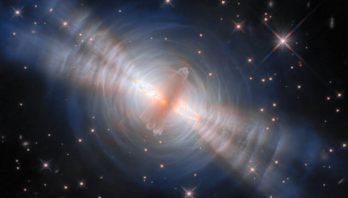
Gemini South Celebrates 25th Anniversary With Stunning Snapshot of the Butterfly Nebula

Gemini South Celebrates 25th Anniversary With Stunning Snapshot of the Butterfly Nebula

To celebrate 25 years since the completion of the International Gemini Observatory, students in Chile voted for the Gemini South ...
Mosaic titled “Red Giant Echoes with Roman,” which shows 11 artist’s concepts of stars, including the Sun and 10 red giants of various radii against a black background. The illustrations are organized roughly into three rows with the grid size of the largest red giant star, located in the bottom right, the equivalent of two rows. Each star is depicted as a bright and blotchy orb. Starting with the mosaic’s smallest star, the Sun, in the top left corner and shifting to the right before moving to the next row, the illustrations become gradually larger and change from shades of light orange to red-orange. Each star’s radius is placed at the bottom of its grid. From left to right, the four light orange stars in the top row are listed with the following radii: Sun, Radius 1.0; Radius 6.3; Radius 7.0, and Radius 7.8. The second row has three orange stars and reads: Radius 8.8; Radius 9.7; and Radius 10.7. The third has four red-orange stars and reads: Radius 11.8; Radius 15.0; Radius 20.1; and Radius 33.7.

NASA’s Roman Could Bring New Waves of Information on Galaxy’s Stars

A team of researchers has confirmed stars ring loud and clear in a “key” that will harmonize well with the ...
Webb First to Show 4 Dust Shells ‘Spiraling’ Apep, Limits Long Orbit

Webb First to Show 4 Dust Shells ‘Spiraling’ Apep, Limits Long Orbit

NASA’s James Webb Space Telescope has delivered a first of its kind: a crisp mid-infrared image of a system of ...
Ua ʻŌhiʻa Lani: An Image to Celebrate Gemini North’s 25th Anniversary features a red-orange background dotted by stars. Tall dark pillars of gas and dust rise in the foreground.

Students in Hawai‘i Name Mesmerizing Image Ua ʻŌhiʻa Lani for the International Gemini Observatory’s 25th Anniversary

To celebrate 25 years since the completion of the International Gemini Observatory, students in Hawai‘i voted for the Gemini North ...
An artist’s representation of twisting magnetic waves (inset) revealed for the first time by the NSF Inouye Solar Telescope. These upward-traveling torsional waves coexist with other wave types and may be an essential ingredient in solving the mystery of why the Sun’s atmosphere is so hot. For more information see Morton et al. (2025). Credit: NSF/NSO/AURA/J. Williams

Scientists Spot Long-Hypothesized Twisting Magnetic Waves in the Sun’s Corona with NSF Inouye Solar Telescope, Hinting at a Hidden Engine Driving Key Solar Phenomena

For more than half a century, scientists have been puzzled by one of the Sun’s unsolved mysteries: why is its ...
Slightly curved thin luminous lines from purple to turquoise to green to red and then yellow, run vertically over on a black background.

New Instrument at SOAR Achieves First Light with Observations of Remarkable Binary Star System

The SOAR Telescope, located on Cerro Pachón in Chile, has received a major upgrade with the installation of the SOAR ...
A wide view of a region of space filled with stars and clumps of orange clouds.

NASA’s Webb Explores Largest Star-Forming Cloud in Milky Way

NASA’s James Webb Space Telescope has revealed a colorful array of massive stars and glowing cosmic dust in the Sagittarius ...
Gaseous yellow-orange filaments look like a rose seen from the side and tilted slightly from upper left to lower right, slightly higher than the center of the frame. Extending from the rose to upper left and lower right are gaseous outflows that appear as red lobes that have an overall shape of tall, narrow triangles with rounded tips. Each red triangle is made up of wavy, irregular lines. Dozens of stars are scattered across the field. One particularly bright white star with eight diffraction spikes is located at the top of the yellow rose. Another bright blue star with even more prominent diffraction spikes is to its lower left. The background of space is black.

NASA’s Webb Observes Immense Stellar Jet on Outskirts of Our Milky Way

A blowtorch of seething gasses erupting from a volcanically growing monster star has been captured by NASA’s James Webb Space ...
A glowing ball with a gold halo and tail streaks to the right in the center of this image. The black background is cover with rainbow colored streaks throughout the image.

Gemini South Captures Growing Tail of Interstellar Comet 3I/ATLAS During Educational Observing Program

Astronomers and students working together through a unique educational initiative have obtained a striking new image of the growing tail ...