
A 4π Framework for Forecasting Solar‑Limb Flares Using the AFT Model and NSF-NOAA GONG Far-Side Helioseismic Maps
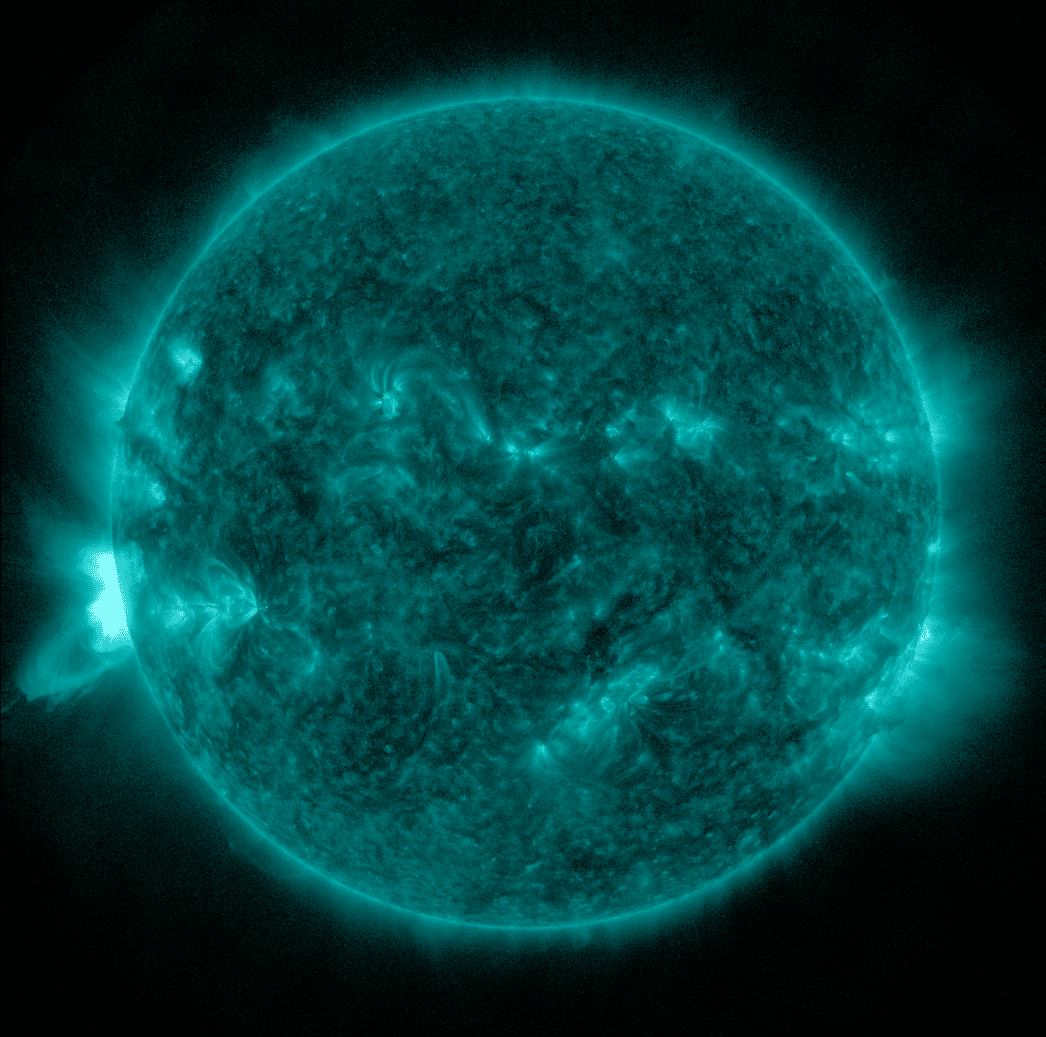
SUMMARY: Solar flares threaten Earth’s satellites, communications, and power grids, yet forecasting them near the Sun’s edges (limbs) or hidden far side remains a major challenge. To reduce this blind spot, a team from the U.S. National Science Foundation (NSF) National Solar Observatory (NSF NSO), NorthWest Research Associates (NWRA), and Southwest Research Institute (SwRI) developed a new full-Sun “4π” forecasting framework. This system tracks solar active regions across the entire surface by combining magnetic field models, statistical predictions, and far-side helioseismology. When evaluated for limb flares, the approach yields modest overall skill improvements but crucially slashes the number of missed flare events, particularly near the eastern limb. These results prove that existing modeling and observational tools can successfully overcome a known operational limitation, significantly improving our ability to anticipate hazardous space-weather events.
Solar flares are a well-recognized component of space weather, yet operational flare forecasting often fails when the source region of the flares lies near or just beyond the Sun’s visible “edges”, or solar limbs. Two major advances over the past decade have now been combined to demonstrate an approach for predicting these “limb flares,” which can still significantly disrupt communication systems.
The long operational lifetimes of key solar-observing programs, including the ground-based NSF-NOAA Global Oscillations Network Group (NSF-NOAA GONG)—funded by the U.S. National Science Foundation (NSF) and National Oceanic and Atmospheric Administration (NOAA), and established by the NSF National Solar Observatory (NSF NSO)— along with NASA’s Solar and Heliospheric Observatory (SOHO) and Solar Dynamics Observatory (SDO) missions, have produced the extensive datasets needed to develop statistical flare-prediction methods and models capable of emulating the evolution of solar magnetic fields, even after they rotate out of the Sun–Earth line of sight. These long-running observations have also made possible the development of far-side helioseismology, a ground-breaking technique to detect the magnetic active regions in the far hemisphere (thus invisible to Earth) without direct imaging. This novel capability offers highly valuable insight into the Sun’s otherwise “invisible” hemisphere, and holds significant promise for space weather research and awareness.
In a recent project led by Dr. K.D. Leka at NorthWest Research Associates (NWRA), a new “4-π” system was developed to forecast solar flares anywhere on the Sun, including those occurring at or near the solar limbs. This novel approach integrates the Advective Flux Transport (AFT) model of Dr. Lisa Upton of the Southwest Research Institute (SwRI) with information about far-side active regions derived from GONG helioseismic maps provided by Dr. Kiran Jain of the National Solar Observatory. The resulting 4-π maps of the magnetic fields are used by a statistical framework to deliver flare predictions for the whole Sun, including for the East limb – crucially, before the underlying active region rotates to become visible.
This work demonstrated that the approach could improve predictions for limb flares, addressing a long-standing operational failure mode. The “4π forecasting framework” also has the potential to predict solar energetic events originating on the far side of the Sun – events that may not affect Earth directly but could impact other locations in the solar system, such as Mars.
Dr. Leka explains: “As part of the 2019 team that first identified this systematic ‘limb-flare’ shortcoming in operational forecasts, it was immediately clear to me that flux-transport models and, especially, far-side helioseismology could help. I am proud to have led this NWRA/SwRI/NSO team to establish and demonstrate this framework. Substantial infrastructure was developed, including enhancements to AFT to incorporate the information from the GONG far-side helioseismology, and the needed methodology to evaluate improvements in limb-flare prediction. The team worked superbly together.”
“Since far‑side active regions are critical for forecasting flares near both limbs and without their direct observations, the helioseismic mapping is particularly crucial when new active regions emerge on the far side. This capability provides the information for assimilating these regions into global magnetic‑field models for reliable forecasting,” says Dr. Jain.
This research was a collaborative effort by NWRA, SwRI, and NSO, supported by NASA grants to NWRA and SwRI. The study utilizes data and the scientific expertise from NSF-NOAA GONG, a facility of the NSO Integrated Synoptic Program (NISP) funded by the NSF and NOAA.
This document was prepared by Dr. Kiran Jain with contributions from Dr. K.D. Leka and Dr. Lisa Upton. The paper describing this work, titled “Addressing Known Challenges in Solar Flare Forecasting I: Limb-Flare Prediction With a 4π Full-Heliosphere Framework” has been published in Space Weather.