
NASA’s Hubble Dazzles With Young Stars in Trifid Nebula
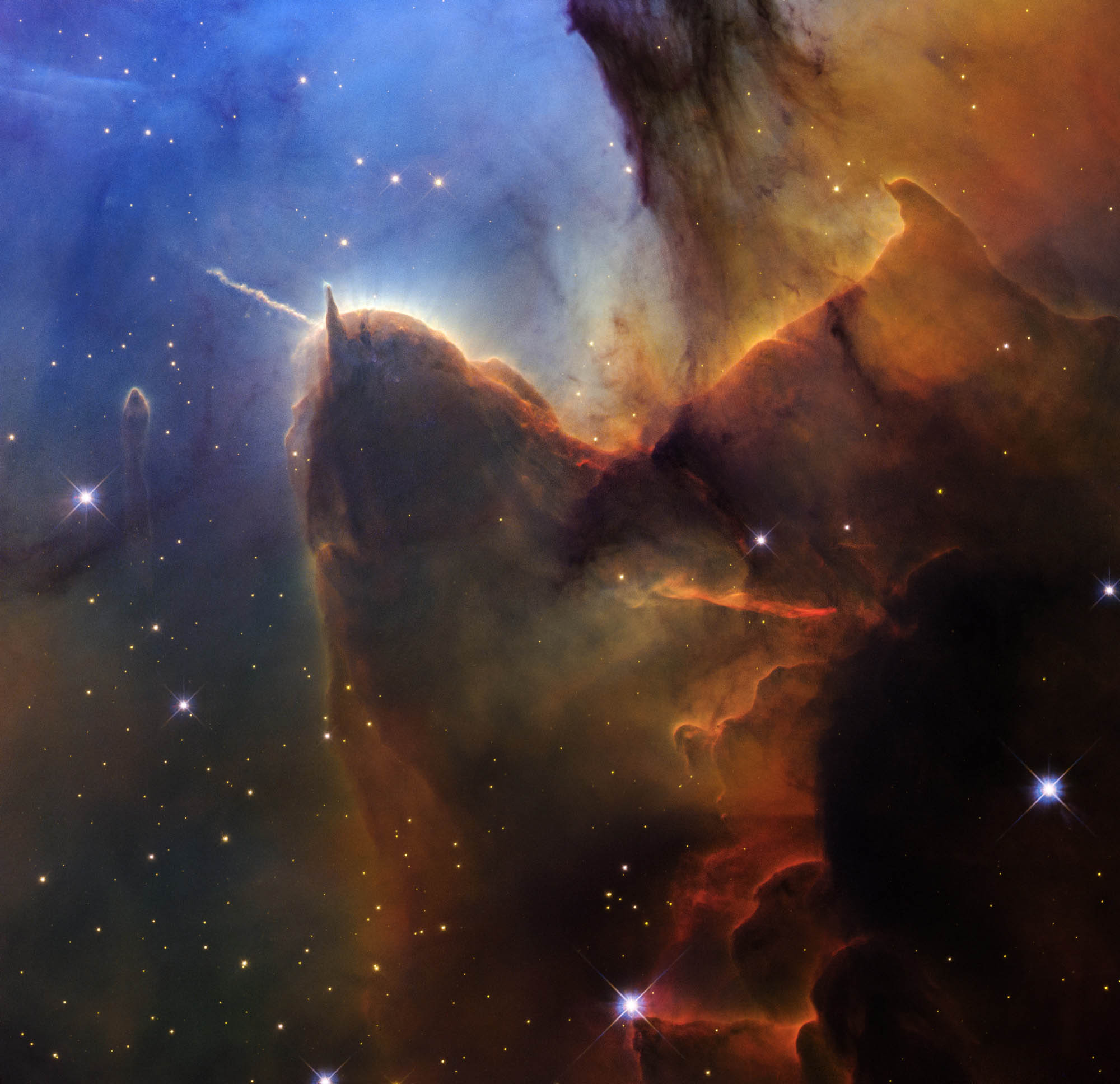
This shimmering region of star-formation, a close-up of the Trifid Nebula about 5,000 light-years from Earth, was captured in intricate detail by NASA’s Hubble Space Telescope. The colors in Hubble’s visible light image, which marks the 36th anniversary of the mission’s launch on April 24, are reminiscent of an underwater scene filled with fine-grained sediments fluttering through the ocean’s depths.
Several massive stars, which are outside this field of view, have shaped this region for at least 300,000 years. (See them in a wider view.) Their powerful winds continue to blow an enormous bubble, a small portion of which is shown here, that pushes and compresses the cloud’s gas and dust, triggering new waves of star formation.
This isn’t the first time Hubble has gazed at this scene. The telescope observed the Trifid in 1997 and now, 29 years later, it has leveraged almost its full operational lifetime to show us changes in the nebula on human time scales. Why look at the same location again? In addition to seeing changes over time, Hubble is also equipped with an improved camera with a wider field of view and greater sensitivity that was installed during Servicing Mission 4.
Star formation in ‘Cosmic Sea Lemon’
Hubble’s view of the Trifid Nebula (also known as Messier 20 or M20) focuses on a “head” and undulating “body” of a rusty-colored cloud of gas and dust that resembles a marine sea lemon, or sea slug, that appears as if it is gliding through the cosmos.
The Cosmic Sea Lemon’s left “horn” is part of Herbig-Haro 399, a jet of plasma periodically ejected over centuries by a young protostar embedded in the head of the sea lemon. Changes, as seen in the video below, allow researchers to measure the speeds of the outflows and determine how much energy the protostar is injecting into these regions. These measurements will provide insights into how newly formed stars interact with their surroundings.
To the immediate lower right is evidence of the counter jet: jagged orange and red lines that ”run” down the back of the sea lemon’s neck, where a natural V appears in the brown dust.
The darker, more triangular “horn” on the right of the “head” hosts another young star at its tip. Zoom in to see a faint red dot with a tiny jet. The green arc above it may be evidence that a circumstellar disk is being eroded by the intense ultraviolet light from nearby massive stars. The clearer area around this protostar suggests it may almost be finished forming.
To the immediate left of the Cosmic Sea Lemon is a small, faint pillar that resembles a water bear. Much of this pillar’s gas and dust has been blown away, but the densest material at the top persists.
Streaks and sharp lines offer more clues about other young stars’ activities. Spy an example by looking near the center for a rippling angled line that begins in a bright orange and ends in a blazing red. In the image comparison, it appears to move, which means it may be a jet shot out by another actively forming star buried deeply in dust.