
NASA’s Hubble Captures Light Show Around Rapidly Dying Star
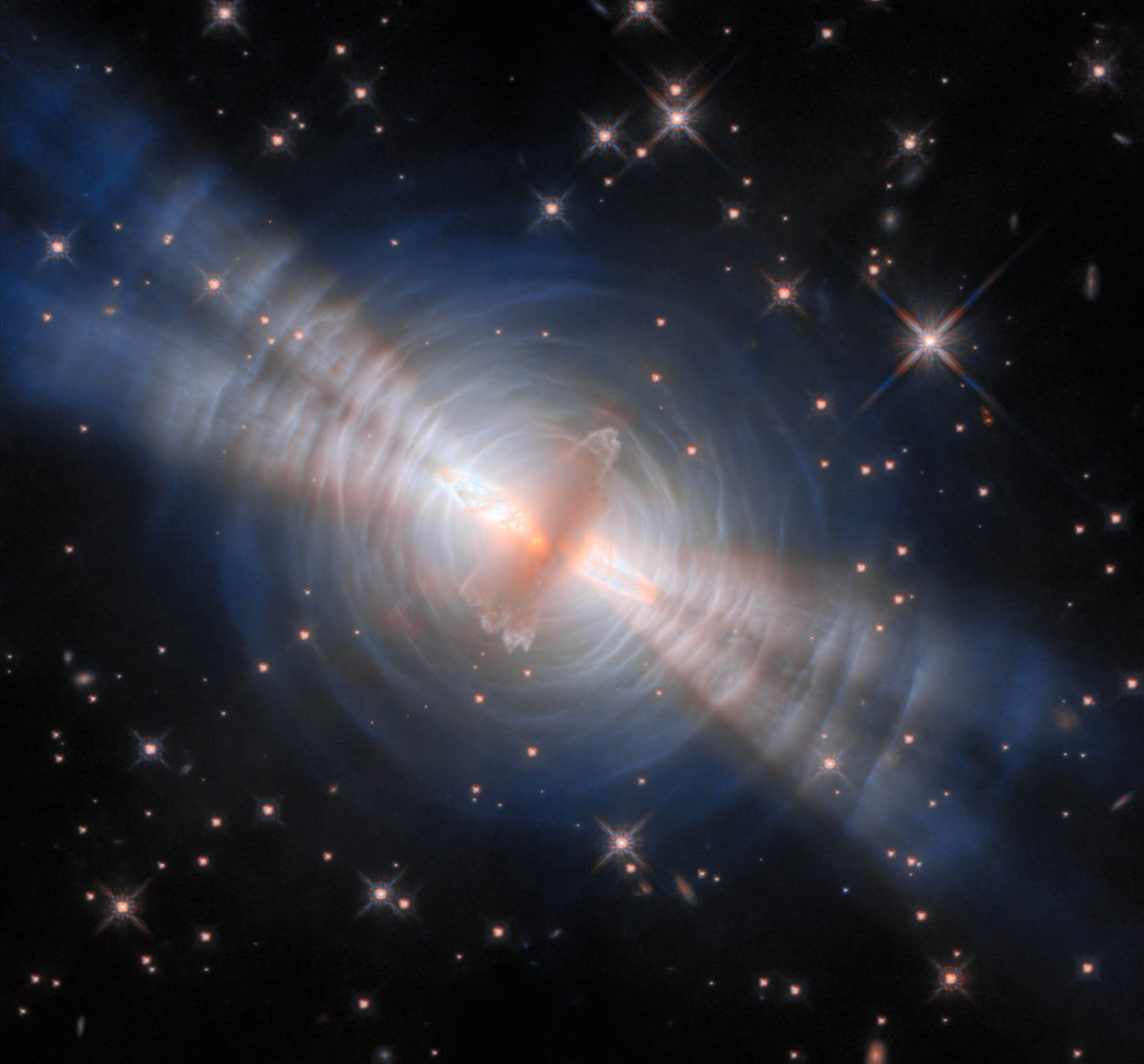
This stunning image from NASA’s Hubble Space Telescope reveals a dramatic interplay of light and shadow in the Egg Nebula, sculpted by freshly ejected stardust. Located approximately 1,000 light-years away in the constellation Cygnus, the Egg Nebula features a central star obscured by a dense cloud of dust — like a “yolk” nestled within a dark, opaque “egg white.” Only Hubble’s sharpness can unveil the intricate details that hint at the processes shaping this enigmatic structure.
It is the first, youngest, and closest pre-planetary nebula ever discovered. (A pre-planetary nebula is a precursor stage of a planetary nebula, which is a structure of gas and dust formed from the ejected layers of a dying, Sun-like star. The term is a misnomer, as planetary nebulae are not related to planets.)
The Egg Nebula offers a rare opportunity to test theories of late-stage stellar evolution. At this early phase, the nebula shines by reflecting light from its central star, which escapes through a polar “eye” in the surrounding dust. This light emerges from a dusty disk expelled from the star’s surface just a few hundred years ago.
Twin beams from the dying star illuminate fast-moving polar lobes that pierce a slower, older series of concentric arcs. Their shapes and motions suggest gravitational interactions with one or more hidden companion stars, all buried deep within the thick disk of stardust.
Stars like our Sun shed their outer layers as they exhaust their hydrogen and helium fuel. The exposed core becomes so hot that it ionizes surrounding gas, creating the glowing shells seen in planetary nebulae such as the Helix, Stingray, and Butterfly nebulae. However, the compact Egg Nebula is still in a brief transitional phase — known as the pre-planetary stage — that lasts only a few thousand years. This makes it an ideal time to study the ejection process while the forensic evidence remains fresh.
The symmetrical patterns captured by Hubble are too orderly to result from a violent explosion like a supernova. Instead, the arcs, lobes, and central dust cloud likely stem from a coordinated series of poorly understood sputtering events in the carbon-enriched core of the dying star. Aged stars like these forged and released the dust that eventually seeded future star systems, such as our own solar system, which coalesced into Earth and other rocky planets 4.5 billion years ago.