
NSF NOIRLab
NSF NOIRLab is the preeminent U.S. national center for ground-based, nighttime optical and infrared astronomy. NOIRLab enables breakthrough discoveries in astrophysics by developing and operating state-of-the-art observatories and providing data products and services for the astronomical community.
Through its five programs — Cerro Tololo Inter-American Observatory, the Community Science and Data Center, International Gemini Observatory, Kitt Peak National Observatory and the Vera C. Rubin Observatory once operational — U.S. National Science Foundation (NSF) NOIRLab serves as a focal point for community development of innovative scientific programs, the exchange of ideas, and creative development. The lab’s infrastructure enables the astronomy community to advance humanity’s understanding of the Universe by exploring significant areas of astrophysics, including dark energy and dark matter, galaxies and quasars, the Milky Way, exoplanets, and small bodies in our own Solar System.
NOIRLab enhances the strengths of each facility and provides new opportunities for staff while expanding scientific capabilities and improving the experience for users. By providing cutting-edge facilities that benefit both the staff and the scientific community, the lab positively impacts ground-based nighttime astronomical science. In addition, the lab focuses on developing international collaborations and partnerships to advance ground-based optical and infrared facilities and capabilities.
In collaboration with the astronomical community, partner organizations, other US optical and infrared system operators, and NSF, NOIRLab develops and advances a strategic vision for NSF-funded future optical and infrared facilities.
NOIRLab’s sites are located in Tucson, Arizona, La Serena, Chile and Hilo, Hawai‘i. AURA operates these facilities and NSF NOIRLab under a cooperative agreement with NSF.
Released in celebration of Gemini North’s 25th anniversary, NGC 4449 is a prime example of starburst activity caused by interacting of galaxies.
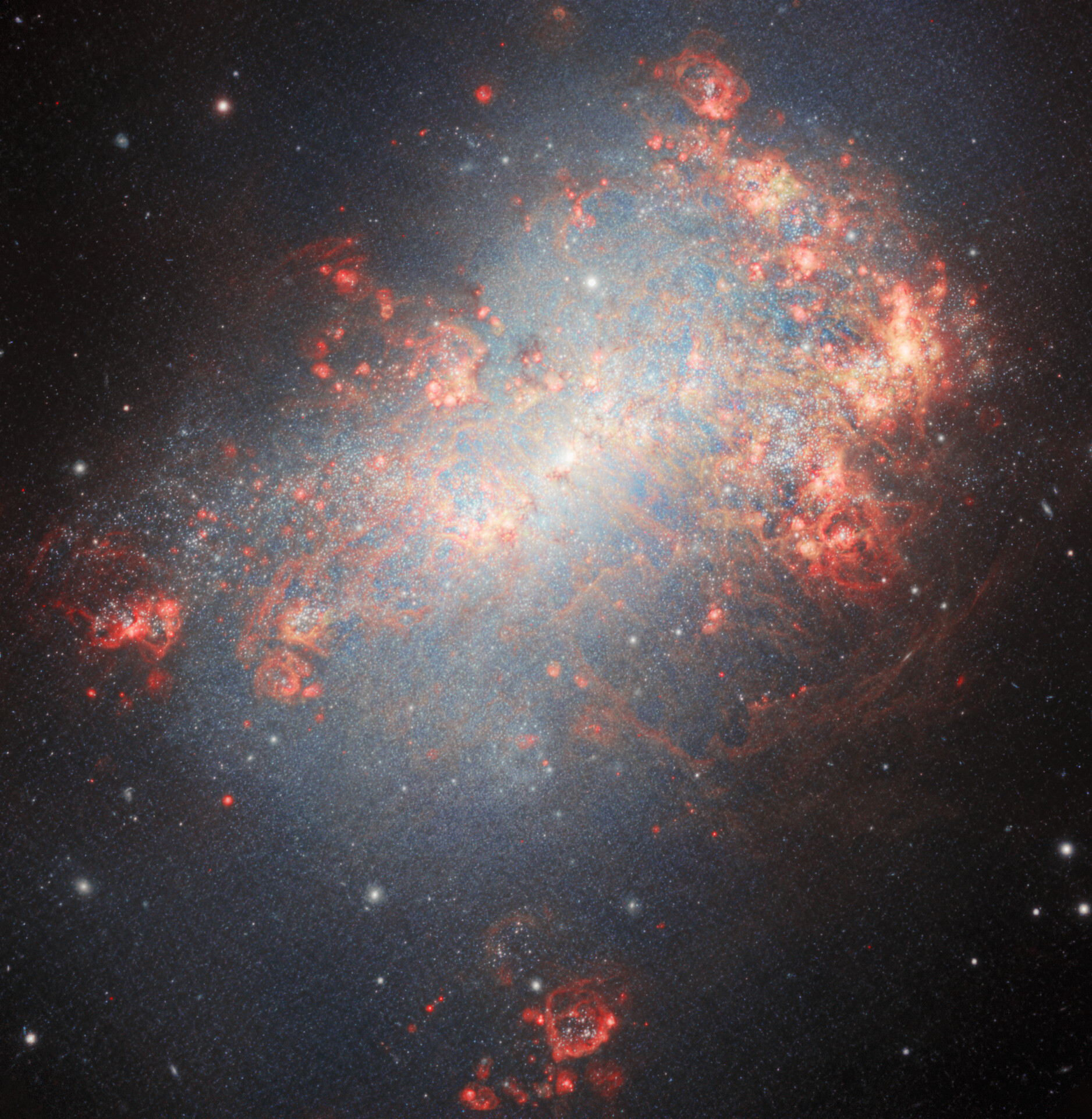
NGC 4449, also known as Caldwell 21, appears to be putting on a cosmic fireworks show in this image captured with the Gemini North telescope, one half of the International Gemini Observatory, which is supported in part by NSF and operated by NSF NOIRLab. The galaxy’s billowing red clouds and sparkling blue veil are lighting up the sky with the colors of newly forming stars. It’s classified as an irregular Magellanic-type galaxy, reflecting its loose spiral structure and close resemblance to the Large Magellanic Cloud — the prototype of Magellanic galaxies.
Stars have been actively forming within NGC 4449 for several billion years, but currently it is pumping out new stars at a much higher rate than in the past. This unusually explosive and intense star formation activity qualifies it as a starburst galaxy. While starbursts usually occur in the central regions of galaxies, NGC 4449’s star formation is more widespread, evidenced by the fact that the youngest stars are both in the nucleus and in streams surrounding the galaxy.