
NASA’s Webb Redefines Dividing Line Between Planets, Stars
Planets, like those in our solar system, form in a bottom-up process where small bits of rock and ice clump together and grow larger over time. But the heftier the planet, the harder it is to explain its formation that way.
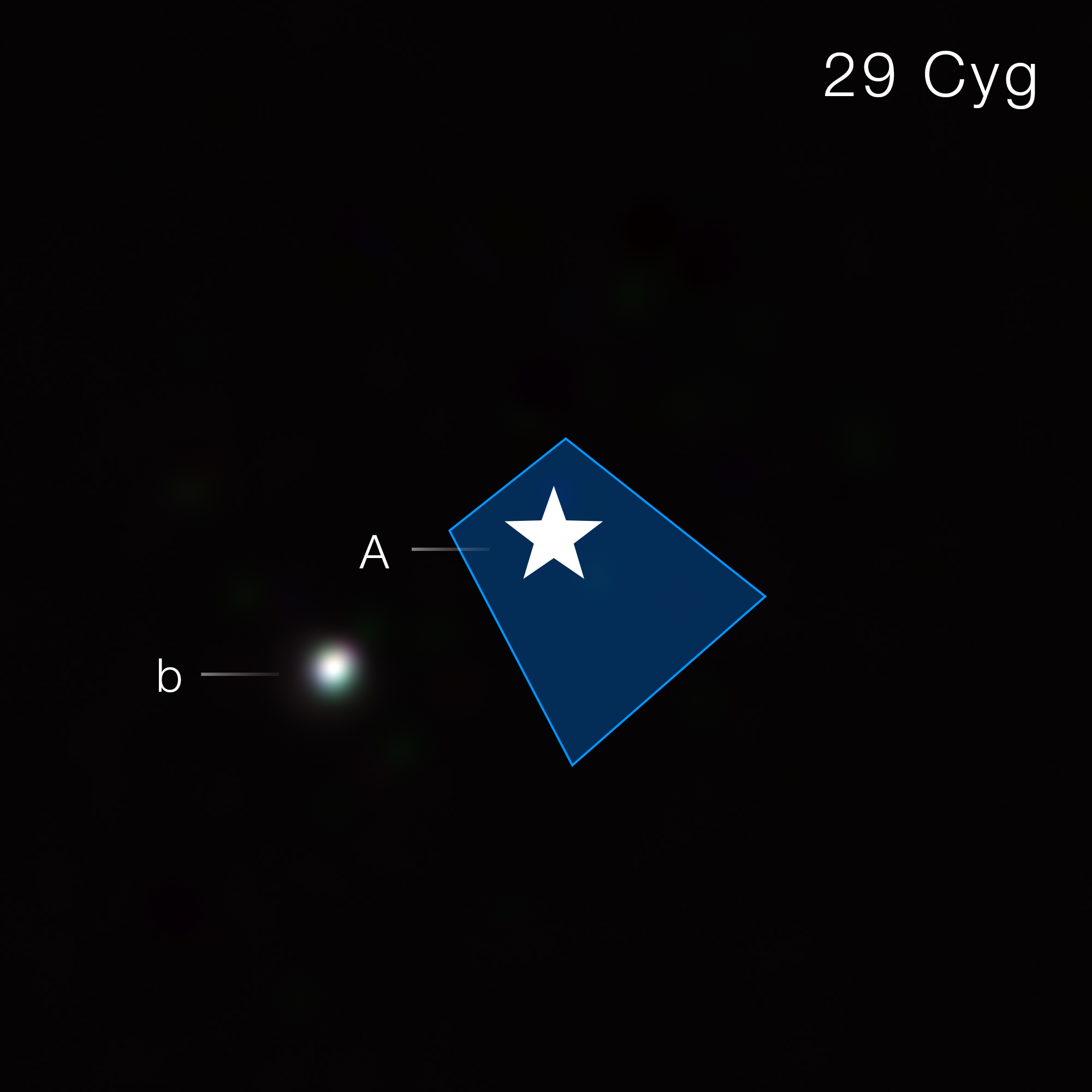
Astronomers used NASA’s James Webb Space Telescope to examine 29 Cygni b, an object about 15 times as massive as Jupiter orbiting a nearby star. They found multiple lines of evidence that 29 Cygni b indeed formed from this bottom-up process, bringing new insights into how the heftiest planets come to be. A paper describing these findings published in The Astrophysical Journal Letters.
The planet formation process is broadly understood to occur within gigantic disks of gas and dust around stars through a process called accretion. Dust gloms together into pebbles, which collide and grow larger and larger, forming protoplanets and eventually planets. The largest then collect gas to become giants like Jupiter. Since it takes more time for gas giants to form, and the disk of planet-forming material eventually evaporates and disappears, planetary systems end up with many more small planets than large planets.
In contrast, stars form when a vast cloud of gas fragments and each piece collapses under its own gravity, growing smaller and denser. A similar fragmentation process could theoretically occur within protoplanetary disks as well. That could explain why some very massive objects are found billions of miles from their host stars, in regions where the protoplanetary disk should have been too tenuous for accretion to occur.
29 Cygni b sits on the dividing line between what can be explained by these two different mechanisms. It weighs 15 times Jupiter and orbits its star at an average distance of 1.5 billion miles (2.4 billion kilometers), about the same as Uranus in our solar system. The research team targeted it because it could potentially result from either process.
“In computer models, it’s very easy for fragmentation in a disk to run away to much higher masses than 29 Cygni b. This is the lowest mass you could plausibly get. But at the same time, it’s about the highest mass you could get from accretion,” said lead author William Balmer of the Johns Hopkins University and the Space Telescope Science Institute, both in Baltimore.
Balmer’s observing program used Webb’s NIRCam (Near-Infrared Camera) in its coronagraphic mode to directly image 29 Cygni b. This planet was the first of four objects targeted by the program, all of which are known to weigh between 1 and 15 times as much as Jupiter. The team also required their targets to orbit within about 9 billion miles (15 billion kilometers) of their stars.
The planets were all young and still hot from their formation, ranging in temperature from about 1,000 to 1,900 degrees Fahrenheit (530 to 1,000 degrees Celsius). This would ensure their atmospheric chemistry was similar to the planets of HR 8799, whose system Balmer studied previously.
By choosing appropriate filters, the team was able to look for signs of light being absorbed by carbon dioxide (CO2) and carbon monoxide (CO), which allowed them to determine the amount of those heavier chemical elements, which astronomers collectively call metals.
They found strong evidence that 29 Cygni b is enriched in metals relative to its host star, which is similar to our Sun in its composition. Given the planet’s mass, the amount of heavy elements it contains is equivalent to about 150 Earths. This suggests that it accreted large amounts of metal-enriched solids from a protoplanetary disk.