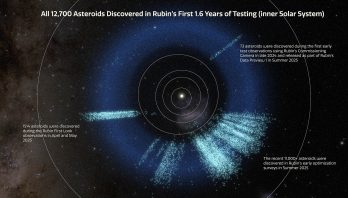
A rendering of the inner Solar System showing the asteroids discovered by Rubin in light teal. Known asteroids are dark blue. The rendering shows a total of almost 12,700 asteroids that were discovered with Rubin over the span of 1.6 years: 73 were discovered during the first early test observations using Rubin’s Commissioning Camera in late 2024 and released as part of Rubin’s Data Preview 1 in Summer 2025; 1514 were discovered during First Look observations in April and May 2025; and the recent 11,000+ asteroids were discovered using observations taken during Rubin’s early optimization surveys in Summer 2025. These are the locations of objects at the time of each object’s discovery. In the time since discovery, the objects have continued in their orbits around the Sun and dispersed from the narrow “pencil beam” rays seen in this graphic. See this in the animation of the model here

Early Data from NSF–DOE Vera C. Rubin Observatory Reveals Over 11,000 New Asteroids

Scientists at NSF–DOE Vera C. Rubin Observatory, jointly funded by the U.S. National Science Foundation and the U.S. Department of ...
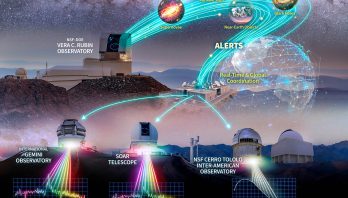
An illustration of NSF NOIRLab's follow-up ecosystem. The telescopes pictured are connected by blue beams of light. The telescopes on the bottom have rainbow beam coming from them representing their observations.

First NSF NOIRLab Follow-Up Observations Triggered by NSF–DOE Rubin Alerts

NSF NOIRLab, funded by the U.S. National Science Foundation, has completed end-to-end runs of its ecosystem for following up on ...
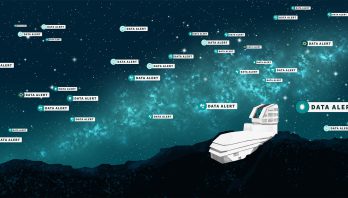
This artist’s illustration represents the start of the alert stream from NSF–DOE Vera C. Rubin Observatory. The summit facility is shown on a rocky ridge. The night sky features stars and the glittering band of the Milky Way Galaxy. The sky is populated with multiple alert “pings,” representing individual alerts from Rubin that something in the sky has changed in brightness or position. Different icons represent various types of alerts, including asteroids, supernovae, active galactic nuclei, and variable stars.

NSF–DOE Vera C. Rubin Observatory Launches Real-Time Discovery Machine for Monitoring the Night Sky

NSF–DOE Rubin Observatory has issued its first scientific alerts, marking a historic milestone in astrophysics. Expected to increase to seven ...
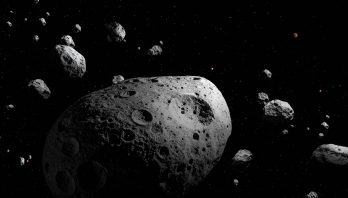
This artist’s illustration depicts 2025 MN45 — the fastest-rotating asteroid with a diameter over 500 meters that scientists have ever found. The asteroid is shown surrounded by many other asteroids, depicting its location within the main asteroid belt. The Sun and Jupiter are shown in the distance. 2025 MN45 is 710 meters (0.44 miles) in diameter, and it completes a full rotation every 1.88 minutes. The discovery was made using data from NSF–DOE Vera C. Rubin Observatory, jointly funded by the U.S. National Science Foundation and the U.S. Department of Energy's Office of Science.

NSF–DOE Vera C. Rubin Observatory Spots Record-Breaking Asteroid in Pre-Survey Observations

First peer-reviewed paper using LSST Camera data identifies an asteroid, nearly the size of eight football fields, rotating every two ...
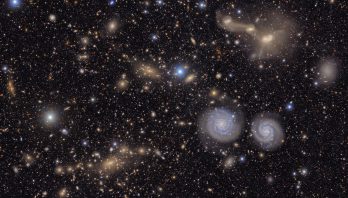
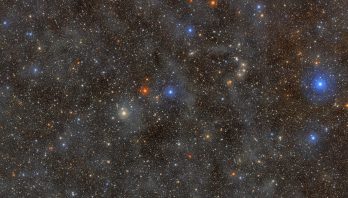
Many stars and galaxies including two spiral galaxies and three merging galaxies.

Ever-changing Universe Revealed in First Imagery From NSF–DOE Vera C. Rubin Observatory

The NSF-DOE Vera C. Rubin Observatory, a major new scientific facility jointly funded by the U.S. National Science Foundation and ...
NSF–DOE Vera C. Rubin Observatory First Look unveiling event save-the-date poster.

Mark Your Calendars! NSF–DOE Vera C. Rubin Observatory Will Unveil First Look Images on 23 June 2025

We invite you to attend the live stream of NSF–DOE Vera C. Rubin Observatory’s First Look event, taking place on ...
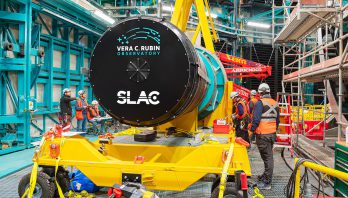
The immense digital camera is slowly being moved into place lifted by a yellow lift.

NSF–DOE Vera C. Rubin Observatory Installs LSST Camera on Telescope

NSF–DOE Vera C. Rubin Observatory, funded by the U.S. National Science Foundation and the U.S. Department of Energy’s Office of ...
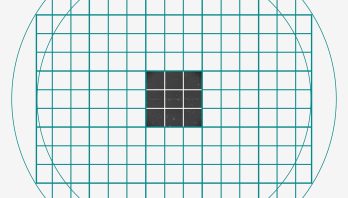
A good comparison of the ComCam engineering test camera with the LSSTCam can be seen in the figure. The two have the same resolution and sensitivity, but the LSSTCam covers 21 times more area on the sky in every image. A single test engineering image from the very first night of the ComCam campaign, before any detailed tuning or more precise alignment of the optical system, is shown in the context of the coverage that will be provided by the LSSTCam: every one of the 21 squares in the teal wire frame is equivalent to another ComCam, all observing the sky at the same time. As ComCam already covers an impressive area equivalent to two full Moons, the promise of the full LSSTCam is incredible.

Testing, Testing! NSF–DOE Vera C. Rubin Observatory Completes Comprehensive System Tests With Flying Colors

After ten years of construction, NSF–DOE Vera C. Rubin Observatory is less than one year away from the start of its transformational ...
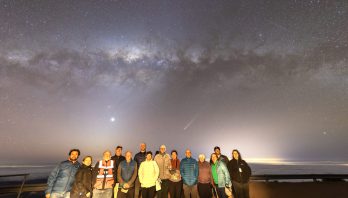
A group poses in front of of a starry sky with a visible comet

NSF Representatives and US Senate Staffers Visit AURA Facilities in Chile

U.S. Senate Appropriations Committee staffers, along with representatives from the National Science Foundation (NSF) and U.S. Embassy, visited the AURA/NOIRLab ...

A group of people stand in front of of a very large telescope at Simonyi Survey Telescope Dedication Ceremony at Rubin Observatory

Simonyi Survey Telescope Dedicated at NSF–DOE Vera C. Rubin Observatory Ceremony

NSF–DOE Vera C. Rubin Observatory celebrated a landmark moment in astronomy and astrophysics with the dedication of the Simonyi Survey ...
AURA Distributes Initial Funding of US $900,000 to Contribute to the Development of Astronomy in Chile

AURA Distributes Initial Funding of US $900,000 to Contribute to the Development of Astronomy in Chile

The fund is connected to the upcoming start of operations of the Vera C. Rubin Observatory and will be administered ...
The LSST Camera is lifted out of its shipping crate on the third level of Rubin Observatory.

LSST Camera Arrives at Rubin Observatory in Chile, Paving the Way for Cosmic Exploration

The largest camera ever built for astrophysics has completed the long journey from SLAC National Accelerator Laboratory in California to ...