
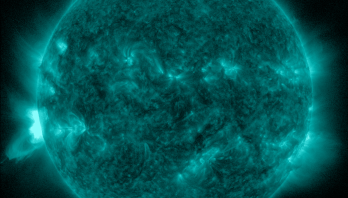
A full-disk extreme ultraviolet visualization of the Sun rendered in a brilliant, textured cyan-teal hue against a black background. The solar surface is covered in intricate, mottle patterns with darker filimentary structures and multiple smaller bright active regions. On the lower-left edge, a blindingly bright white-cyan eruption—a long-duration M-class solar flare—is actively exploding from the limb, with brilliant hot plasma and detailed magnetic loops extending into the void of space, originating from a region just beyond the Sun's edge.

A 4π Framework for Forecasting Solar‑Limb Flares Using the AFT Model and NSF-NOAA GONG Far-Side Helioseismic Maps

Solar flares are a well-recognized component of space weather, yet operational flare forecasting often fails when the source region of ...
Large telescope agains a bright blue sky

NSF National Solar Observatory

The NSF National Solar Observatory (NSO) operates the world’s most extensive collection of ground-based optical and infrared solar telescopes and ...
Illustration showing orange looping ribbons over a pink area that fades to yellow. There are purple curling lines over the pink/yellow area.

Reading the Sun’s Fireworks: How Flare Ribbons Reveal Hidden Solar Explosions

A new study by a team led by U.S. National Science Foundation (NSF) Daniel K. Inouye Solar Telescope Ambassador Marcel ...
Scientific graph divided into 3 sections. Top left is mottled green bottom left and right are blue and red.

NSF-NOAA GONG Maps Hidden Magnetism on the Sun’s Far Side

A team of scientists led by the U.S. National Science Foundation National Solar Observatory developed a new physics-based method to ...
a series of 8 greyscale diamond shaped images of a solar flare on a black background in 2 rows of 4.

New Solar Flare Observations Challenge Leading Theories

Using the NSF Daniel k. Inouye solar telescope, scientists captured highly detailed measurements of a fading solar flare. The findings ...
Close up of the Sun with a dotted rectangular white box over the a part of the outer portion. There is a red line through the white box lengthwise.

Uncovering the Waves That Power the Sun’s Outer Atmosphere

Observations from the U.S. National Science Foundation (NSF) Daniel K. Inouye Solar Telescope—built and managed by the NSF National Solar ...
Illustration of a bright yellow Sun on a dark starry background. The left side is cutaway revealing its inner structure in a red and blue pattern. A quarter is cut away more to reveal the inner core.

30 Years of GONG: The Enduring Legacy of the U.S. National Science Foundation National Solar Observatory Solar Monitoring Network

When the Global Oscillation Network Group (GONG) began operations in 1995, it was designed to run for just three years ...
An illustration of the Solar system with the Sun in bright orange and yellow at the center and a light blue Earth in the foreground – all on a blue background.

Two Eyes on the Sun: Unveiling Solar Dynamics with Coordinated Observations

In October 2022, the U.S. National Science Foundation (NSF) Daniel K. Inouye Solar Telescope and the European Space Agency (ESA) ...
An artist’s representation of twisting magnetic waves (inset) revealed for the first time by the NSF Inouye Solar Telescope. These upward-traveling torsional waves coexist with other wave types and may be an essential ingredient in solving the mystery of why the Sun’s atmosphere is so hot. For more information see Morton et al. (2025). Credit: NSF/NSO/AURA/J. Williams

Scientists Spot Long-Hypothesized Twisting Magnetic Waves in the Sun’s Corona with NSF Inouye Solar Telescope, Hinting at a Hidden Engine Driving Key Solar Phenomena

For more than half a century, scientists have been puzzled by one of the Sun’s unsolved mysteries: why is its ...
A close up image of the Sun with an orange wave-like structure in th middle and bright yellow sections above and below ir. It is covered in dark lines indicating the direction of the wave.

The NSF Inouye Solar Telescope Delivers Record-Breaking Images of Solar Flare, Coronal Loops

On August 8, 2024, the U.S. National Science Foundation (NSF) Daniel K. Inouye Solar Telescope captured the sharpest-ever images of ...
A compact brightening bursts to life at the edge of a sunspot! This multi-instrument figure showcases high-resolution observations of the same active region. Panels a–b show data from the Helioseismic and Magnetic Imager at the NASA Solar Dynamics Observatory. Panels c–e show spectra from the ViSP instrument at the Inouye. Panels f–h show images from the VBI instrument at the Inouye using three different light filters known as G-band, Hβ, and Ca II K. The panels reveal a small-scale, transient brightening (indicated by the black arrow) occurring at the boundary between opposite magnetic polarities (inside the blue box). One arcsecond corresponds to 720 km on the Sun.

Small-Scale Solar Explosion Reveals Big Clues About Magnetic Reconnection

Using the world’s largest solar telescope, a team of scientists has captured one of the most detailed views ever of ...
Magnetic Curtains on the Sun: NSF Inouye Solar Telescope Reveals Ultra-Fine Striations in Solar Surface

Magnetic Curtains on the Sun: NSF Inouye Solar Telescope Reveals Ultra-Fine Striations in Solar Surface

A team of solar physicists has released a new study shedding light on the fine-scale structure of the Sun’s surface ...