
Dark Energy Survey Scientists Release Analysis of All Six Years of Survey Data
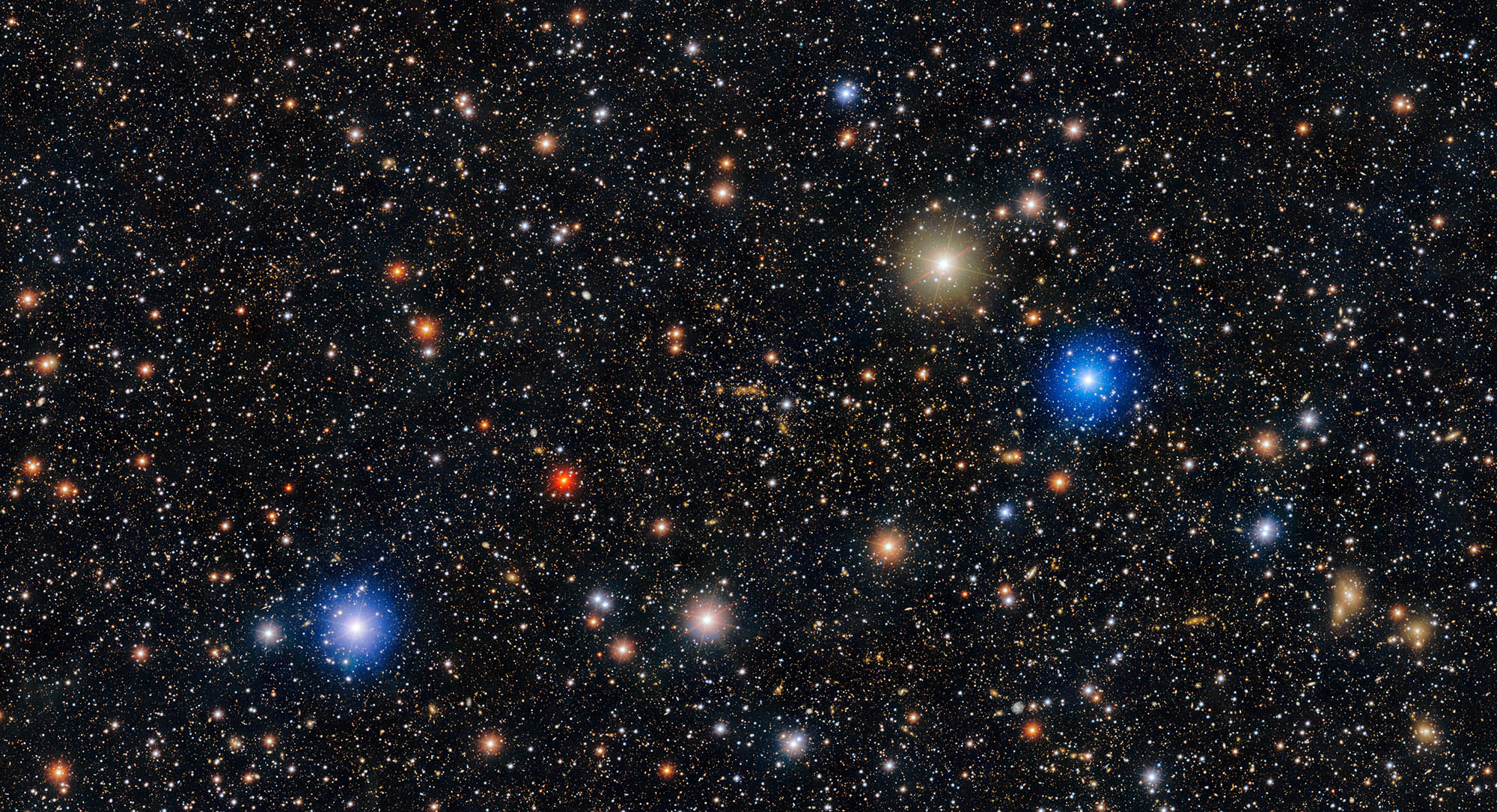
Four methods for studying dark energy come together in a single experiment for the first time
The Dark Energy Survey Collaboration collected information on hundreds of millions of galaxies across the Universe using the U.S. Department of Energy-fabricated Dark Energy Camera, mounted on the U.S. National Science Foundation Víctor M. Blanco 4-meter Telescope at CTIO, a Program of NSF NOIRLab. Their completed analysis combines all six years of data for the first time and yields constraints on the Universe’s expansion history that are twice as tight as past analyses.
The Dark Energy Survey (DES) is an international, collaborative effort to map hundreds of millions of galaxies, detect thousands of supernovae, and find patterns of cosmic structure that will help reveal the nature of the mysterious dark energy that is accelerating the expansion of our Universe.
From 2013 to 2019, the DES Collaboration carried out a deep, wide-area survey of the sky using the 570-megapixel DOE-fabricated Dark Energy Camera (DECam), mounted on the NSF Víctor M. Blanco 4-meter Telescope at NSF Cerro Tololo Inter-American Observatory (CTIO) in Chile. For 758 nights over six years, the DES Collaboration recorded information from 669 million galaxies that are billions of light-years from Earth, covering an eighth of the sky.
Today, the DES Collaboration is releasing results that, for the first time, combine all six years of data from weak lensing and galaxy clustering probes — two techniques for measuring the Universe’s expansion history. The collaboration also presents the first results found by combining all four methods of measuring the expansion history of the Universe — baryon acoustic oscillations (BAO), Type-Ia supernovae, galaxy clusters, and weak gravitational lensing — as proposed at the inception of DES 25 years ago. The paper, submitted to Physical Review D, represents a summary of 18 supporting papers.
“It is an incredible feeling to see these results based on all the data, and with all four probes that DES had planned. This was something I would have only dared to dream about when DES started collecting data, and now the dream has come true,” says Yuanyuan Zhang, assistant astronomer at NSF NOIRLab and member of the DES Collaboration.
The analysis yields new, tighter constraints that narrow down the possible models for how the Universe behaves. These constraints are more than twice as strong as those from past DES analyses while remaining consistent with previous DES results.
“These results from the Dark Energy Survey shine new light on our understanding of the Universe and its expansion,” said Regina Rameika, Associate Director for the Office of High Energy Physics in the DOE’s Office of Science (DOE/SC). “They demonstrate how long-term investment in research and combining multiple types of analysis can provide insight into some of the Universe’s biggest mysteries.”
The first clue for dark energy was uncovered about a century ago when astronomers noticed that distant galaxies appeared to be moving away from us. In fact, the farther away a galaxy is, the faster it recedes. This provided the first key evidence that the Universe is expanding. But since the Universe is permeated by gravity, a force that pulls matter together, astronomers expected the expansion would slow down over time.
Then, in 1998, two independent teams of cosmologists used distant supernovae to discover that the Universe’s expansion is accelerating rather than slowing. To explain these observations, they proposed a new kind of phenomenon that is responsible for driving the Universe’s accelerated expansion: dark energy. Astrophysicists now believe dark energy makes up about 70% of the mass-energy density of the Universe. Yet, we still know very little about it.
In the following years, scientists began devising experiments to study dark energy, including DES. Today, DES is an international collaboration of over 400 astrophysicists and scientists from 35 institutions in seven countries led by DOE’s Fermi National Accelerator Laboratory.