
Two Eyes on the Sun: Unveiling Solar Dynamics with Coordinated Observations
THE FIRST COORDINATED OBSERVATIONS OF THE SUN BY NSF INOUYE SOLAR TELESCOPE AND ESA SOLAR ORBITER ARE NOW AVAILABLE
SUMMARY: In October 2022, the U.S. National Science Foundation (NSF) Daniel K. Inouye Solar Telescope and the European Space Agency (ESA) Solar Orbiter carried out their first coordinated campaign, capturing a decaying solar active region from two perspectives. Together, their instruments produced open-access, high-resolution datasets that reveal intricate details of coronal structures, small-scale flares, and plasma flows. These joint observations not only showcase the potential of stereoscopic solar imaging but also open fresh avenues for tackling long-standing questions about the Sun’s atmosphere dynamic behavior.
The Sun is not just a glowing ball in the sky. From large magnetic loops hundreds of times larger than Earth, to tiny features that blink in and out of existence, our home star is far more dynamic than most of us realize. According to Krzysztof Barczynski, a solar physicist who worked on this research while at ETH Zurich and is now at PMOD/WRC in Davos, “the Sun is an incredibly active and dynamic place, filled with countless tiny features that, despite their small size, play an important role in shaping the solar atmosphere, and influencing larger solar structures.”
Thanks to an unprecedented collaboration led by Barczynski between two of the most advanced solar observatories ever built—on Earth and in space—scientists are now able to dig deeper into our star’s complexity.
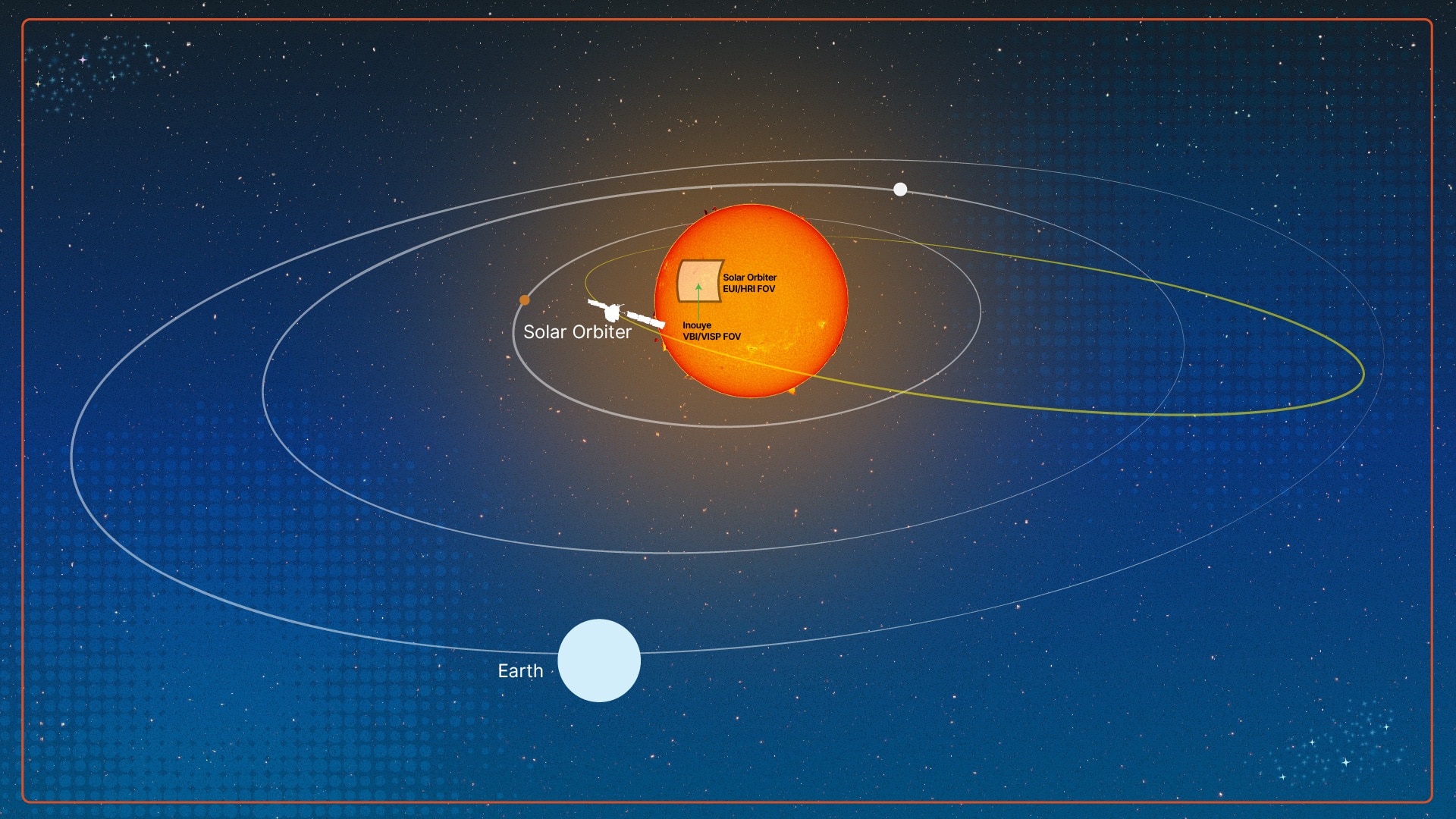
On one end of the collaboration sits the U.S. National Science Foundation (NSF) Daniel K. Inouye Solar Telescope, the largest solar telescope in the world, built and managed by the NSF National Solar Observatory (NSO) near the summit of Maui’s Haleakalā. On the other end, traveling as close as one-third of the Earth-Sun distance, is the space-borne Solar Orbiter (SolO), developed by the European Space Agency (ESA) with support from the National Aeronautics and Space Administration (NASA).
By combining these two vantage points, astronomers are effectively doing what a photographer might do: zooming in (with the Inouye) and moving closer (with SolO). The result? A more complete view of the Sun—both ground-based and space-based, from the surface layers up into the corona.
The Inouye is tuned to the Sun’s middle layers (the photosphere and chromosphere), as well as the corona, around the solar limb; while Solar Orbiter captures the hotter, more ethereal realms of the transition region (between the chromosphere and the corona) and the corona. Together, the instruments provide an unprecedented sort of 3D, stereo view of solar structures—allowing scientists to trace structures from their roots up through to how they evolve.