
Webb First to Show 4 Dust Shells ‘Spiraling’ Apep, Limits Long Orbit
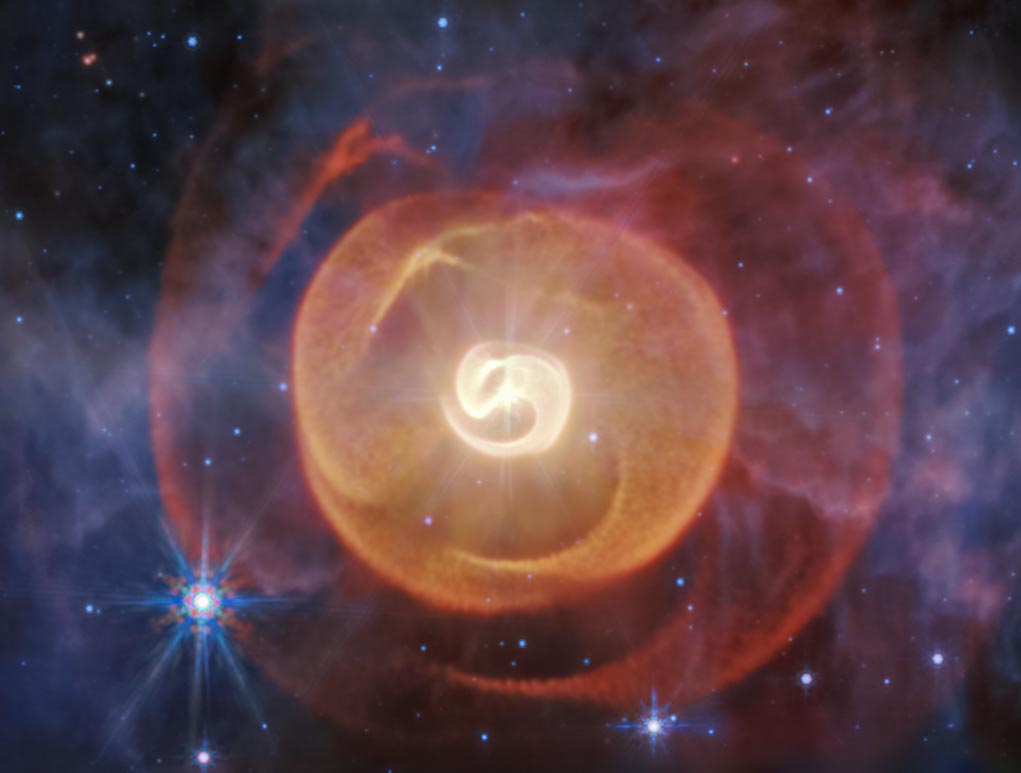
NASA’s James Webb Space Telescope has delivered a first of its kind: a crisp mid-infrared image of a system of four serpentine spirals of dust, one expanding beyond the next in precisely the same pattern. (The fourth is almost transparent, at the edges of Webb’s image.) Observations taken prior to Webb only detected one shell, and while the existence of outer shells was hypothesized, searches using ground-based telescopes were unable to uncover any. These shells were emitted over the last 700 years by two aging Wolf-Rayet stars in a system known as Apep, a nod to the Egyptian god of chaos.
Webb’s image combined with several years of data from the European Southern Observatory’s Very Large Telescope (VLT) in Chile narrowed down how often the pair swing by one another: once every 190 years. Over each incredibly long orbit, they pass closely for 25 years and form dust.
Webb also confirmed that there are three stars gravitationally bound to one another in this system. The dust ejected by the two Wolf-Rayet stars is “slashed” by a third star, a massive supergiant, which carves holes into each expanding cloud of dust from its wider orbit. (All three stars are shown as a single bright point of light in Webb’s image.)
High-speed ‘skirmish’
The dust-producing Wolf-Rayet stars in Apep aren’t exactly on a tranquil cruise. They are whipping through space and sending out dust at 1,200 to 2,000 miles per second (2,000 to 3,000 kilometers per second).
That dust is also very dense. The specific makeup of the dust is another reason why Webb was able to observe so much more: It largely consists of amorphous carbon. “Carbon dust grains retain a higher temperature even as they coast far away from the star,” Han said. While the exceptionally tiny dust grains are considered warm in space, the light they emit is also extremely faint, which is why it can only be detected from space by Webb’s MIRI (Mid-Infrared Instrument).
Slicing dust
To find the holes the third star has cut like a knife through the dust, look for the central point of light and trace a V shape from about 10 o’clock to 2 o’clock. “The cavity is more or less in the same place in each shell and looks like a funnel,” White said.
“I was shocked when I saw the updated calculations play out in our simulations,” he said. “Webb gave us the ‘smoking gun’ to prove the third star is gravitationally bound to this system.” Researchers have known about the third star since the VLT observed the brightest innermost shell and the stars in 2018, but Webb’s observations led to an updated geometric model, clinching the connection.