
NSF-NOAA GONG Maps Hidden Magnetism on the Sun’s Far Side
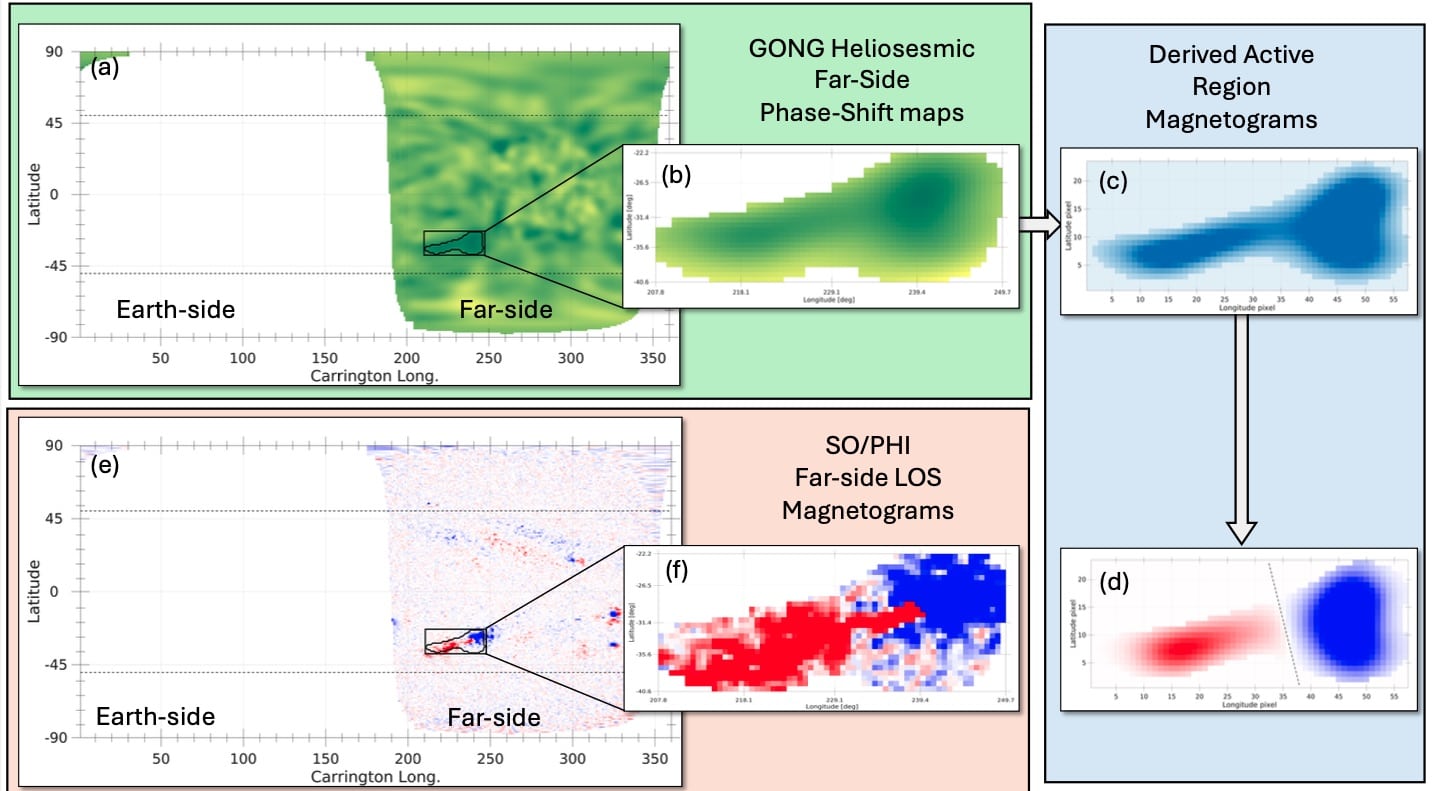
A team of scientists led by the U.S. National Science Foundation National Solar Observatory developed a new physics-based method to assign magnetic polarities to far-side sunspots. By characterizing regions already identified through helioseismology, this breakthrough turns basic detections into detailed magnetic maps of the invisible solar surface to improve space weather forecasting.
For observers on Earth, the Sun appears as a bright, familiar disk—but what we see is only half the story. Like the Moon, one half of the Sun is permanently hidden from our direct view: the far side beyond the visible solar limb. Yet, activity brewing there can eventually turn toward Earth, sometimes unleashing solar flares and eruptions capable of disrupting human technology.
A quarter of a century ago, scientists devised a way to detect these invisible threats before they rotate into view. Using a technique known as helioseismology, scientists analyze sound waves reverberating inside the Sun to locate large active regions forming on its hidden half. These methods can reveal the presence of sunspot groups days before they become visible from Earth.
“Helioseismology has allowed us to detect where active regions exist on the far side of the Sun,” says the lead author of this work, Dr. Amr Hamada of the U.S. National Science Foundation National Solar Observatory (NSF NSO). “However, until recently we could not determine one of their most important properties: the magnetic polarity.”
Magnetic polarity describes how magnetic fields are oriented, with positive polarity pointing outward from the Sun and negative polarity field pointing inward. This structure governs how solar magnetic fields interact with its surroundings, and whether its eruption might produce a powerful geomagnetic storm or merely a weak one.
The breakthrough comes from a new analysis of helioseismic observations collected by the NSF-NOAA Global Oscillation Network Group (NSF-NOAA GONG), built and operated by the NSO with support from the National Oceanic and Atmospheric Administration (NOAA).
“Although magnetic fields have been estimated before, the novelty here lies in the physics‑driven determination of magnetic polarities and tilt angle within the helioseismically identified active regions” explains Dr. Kiran Jain, the Lead Scientist of the NSO Far Side Project and a co-author on this study.
NSF-NOAA GONG is a worldwide network of robotic solar telescopes that continuously monitors the subtle oscillations rippling across the Sun’s surface. These oscillations—caused by waves traveling through the Sun’s interior—carry information about our star’s internal structures and magnetic features. “The Sun is constantly ringing with sound waves,” Hamada says. “By measuring how those waves travel through the solar interior, we can learn about structures both inside the Sun, and on the far side of its surface.”
“For more than two decades, the Sun’s oscillations have been used to produce far-side maps that reveal where large active regions exist. But the new work shows that the waves contain additional clues hidden in their patterns” says Dr. Alexei Pevtsov, the NSO Associate Director for NSO’s Synoptic Program responsible for NSF-NOAA GONG operations.