
First NSF NOIRLab Follow-Up Observations Triggered by NSF–DOE Rubin Alerts
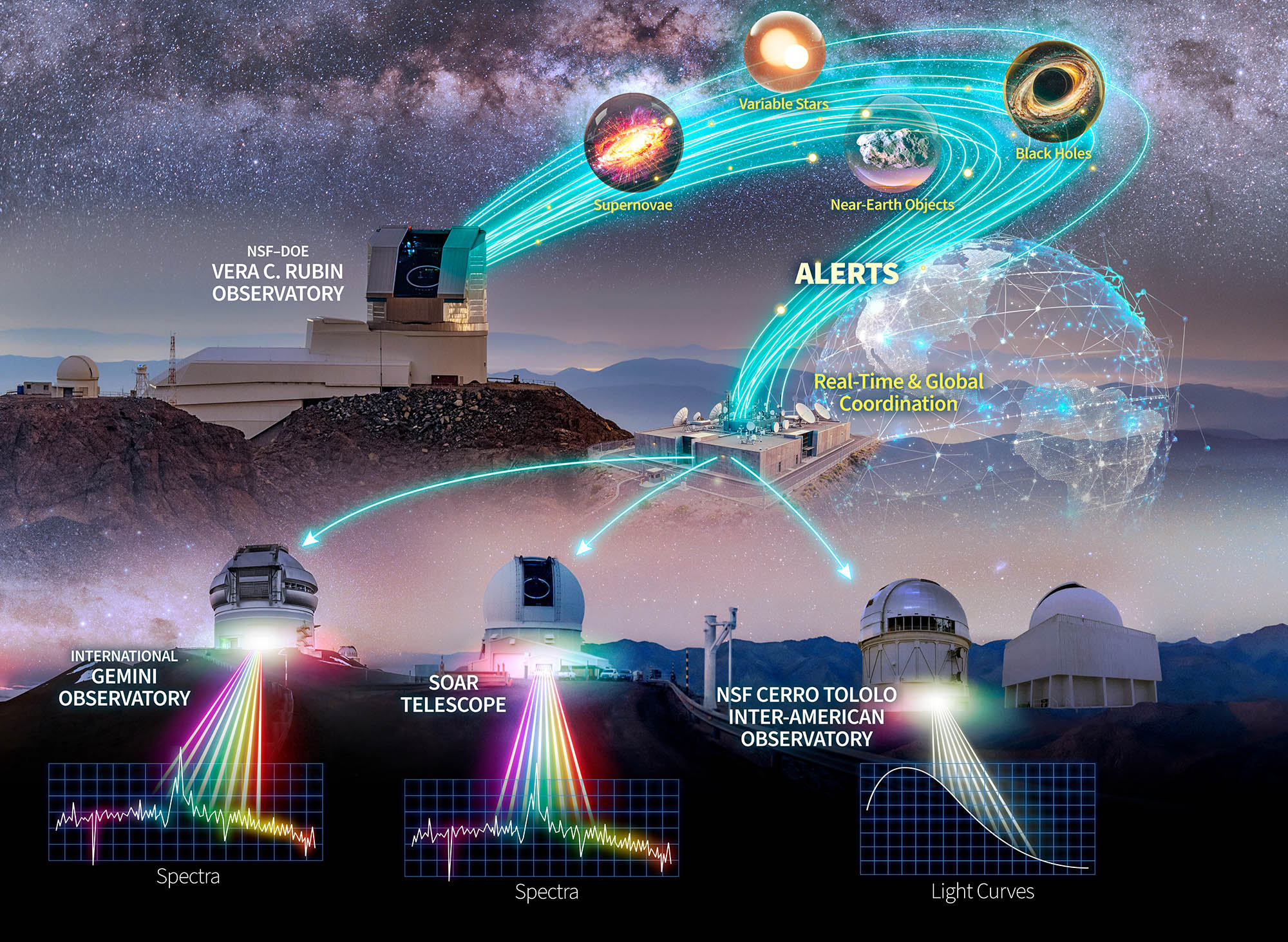
Multiple NOIRLab tools and facilities come together to demonstrate end-to-end use of its real-time follow-up ecosystem
NSF NOIRLab, funded by the U.S. National Science Foundation, has completed end-to-end runs of its ecosystem for following up on alerts from NSF–DOE Vera C. Rubin Observatory. The runs demonstrated how multiple NOIRLab-developed software tools, plus a network of telescopes around the globe, will enable quick follow-up observations of the countless transient objects that Rubin will uncover during its ten-year survey.
NSF NOIRLab has successfully demonstrated end-to-end use of its real-time follow-up ecosystem designed to quickly respond to alerts generated by NSF–DOE Vera C. Rubin Observatory, which is jointly funded by the U.S. National Science Foundation (NSF) and the U.S. Department of Energy’s Office of Science (DOE/SC). Alerts from Rubin point the scientific community to objects in the night sky that change in position or brightness, such as asteroids, interstellar comets, and exploding stars. Due to their fleeting nature, rapid follow-up observations are crucial for studying these objects.
NOIRLab has developed a series of tools to enable scientists to quickly and efficiently follow-up on alerts from Rubin. These tools include an alert-filtering system, an automatic observation request manager, a network of telescopes to carry out observations, and automatic data reduction software. Together these tools make up an integrated ecosystem that helps process the millions of alerts that Rubin is expected to generate every night once it begins its Legacy Survey of Space and Time (LSST).
To interpret the immense flow of data from Rubin, scientists rely on a network of intelligent software platforms known as brokers. These systems use machine learning algorithms to filter, sort, and classify the alerts before distributing them to the scientific community.
NOIRLab operates one of these community brokers: the Arizona–NOIRLab Temporal Analysis and Response to Events System (ANTARES). This sophisticated software tool receives alerts from Rubin and filters them in real time into categories depending on the object’s characteristics. Scientists can subscribe to filters and be notified of new alerts for objects that are of interest to them, whether that be supernovae, variable stars, objects that shine in a specific wavelength of light, or variable objects that are located in a certain region of sky.
Once ANTARES filters the alerts, it sends them to another NOIRLab-built software tool called the Gemini Observation and Analysis of Targets System (GOATS). GOATS was developed by the Science User Support Department (SUSD) of the International Gemini Observatory, funded in part by the NSF and operated by NSF NOIRLab. This browser-based interface allows selection of objects for follow-up and automatically submits the observation requests to a network of telescopes called the Astronomical Observatory Event Network (AEON).
AEON is a collaboration of telescopes located around the world, including: the NSF Víctor M. Blanco 4-meter telescope at NSF Cerro Tololo Inter-American Observatory (CTIO) in Chile, a Program of NSF NOIRLab; the SOAR 4.1-meter telescope located on Cerro Pachón in Chile and operated by CTIO; the Gemini South telescope in Chile and the Gemini North telescope in Hawaiʻi; and the global network of telescopes that make up the Las Cumbres Observatory. Las Cumbres Observatory runs the robotic scheduling software that AEON uses to manage the incoming observation requests for SOAR and Blanco.