
STScI: Tiny Neptune Moon Spotted by Hubble May Have Broken from Larger Moon
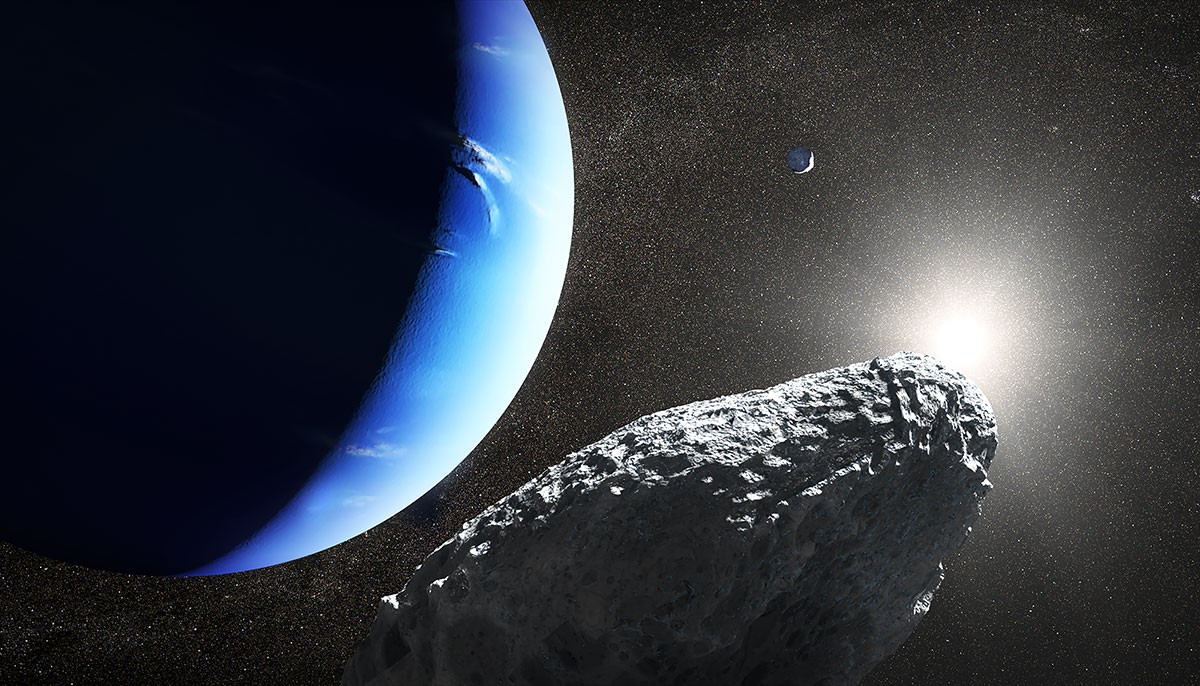 This is an artist’s concept of the tiny moon Hippocamp that was discovered by the Hubble Space Telescope in 2013. Only 20 miles across, it may actually be a broken-off fragment from a much larger neighboring moon, Proteus, seen as a crescent in the background. This is the first evidence for a moon being an offshoot from a comet collision with a much larger parent body. Credit: NASA, ESA, and J. Olmsted (STScI)
Astronomers call it “the moon that shouldn’t be there.”
After several years of analysis, a team of planetary scientists using NASA’s Hubble Space Telescope has at last come up with an explanation for a mysterious moon around Neptune that they discovered with Hubble in 2013.
The tiny moon, named Hippocamp, is unusually close to a much larger Neptunian moon called Proteus. Normally, a moon like Proteus should have gravitationally swept aside or swallowed the smaller moon while clearing out its orbital path.
So why does the tiny moon exist? Hippocamp is likely a chipped-off piece of the larger moon that resulted from a collision with a comet billions of years ago. The diminutive moon, only 20 miles (about 34 kilometers) across, is 1/1000th the mass of Proteus (which is 260 miles [about 418 kilometers] across).