
Bright Blue Cosmic Outbursts Likely Caused by Large Black Holes Shredding Massive Companions
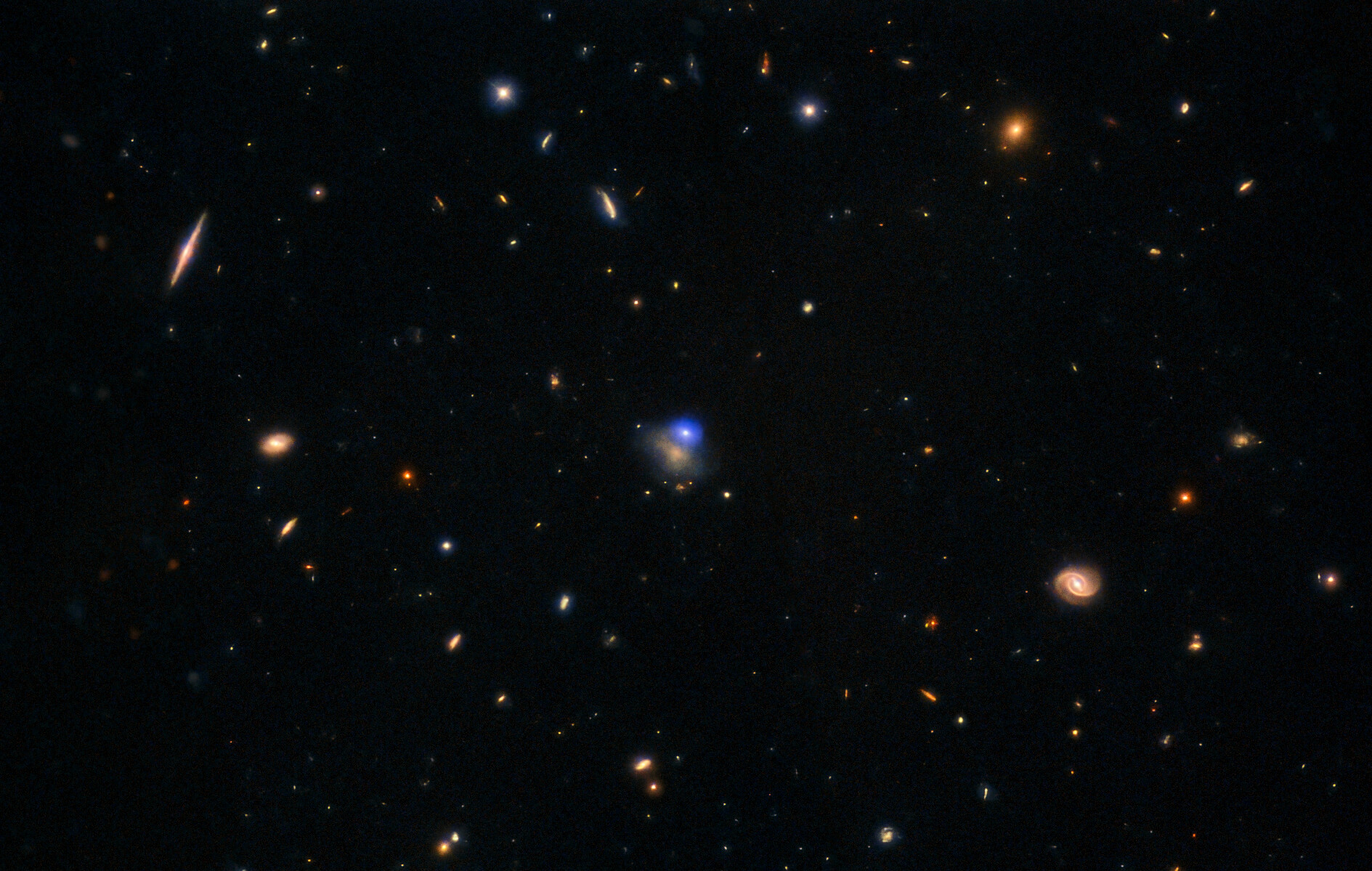
In 2024, astronomers discovered the brightest Luminous Fast Blue Optical Transient (LFBOT) ever observed. LFBOTs are extremely bright flashes of blue light that shine for brief periods before fading away. New analysis of this record-breaking burst, which includes observations from the International Gemini Observatory, funded in part by the U.S. National Science Foundation, challenges all prior understanding of these rare explosive events.
Among the more puzzling cosmic phenomena discovered over the past few decades are brief and very bright flashes of blue and ultraviolet light that gradually fade away, leaving behind faint X-ray and radio emissions. This curious class of objects is known as luminous fast blue optical transients (LFBOTs), and with slightly more than a dozen discovered so far, astronomers have debated whether they are produced by an unusual type of supernova or by interstellar gas falling into a black hole.
Analysis of the brightest LFBOT to-date, named AT 2024wpp and discovered last year, shows that they’re neither. Instead, a team led by researchers from the University of California, Berkeley, concluded that they are caused by an extreme tidal disruption, where a black hole of up to 100 times the mass of our Sun completely shreds its massive star companion within days.
This discovery resolves a decade-long conundrum but also illustrates the many varieties of stellar calamities that astronomers encounter, each with its characteristic spectrum of light that evolves over time. Figuring out the processes that produce these unique light signatures tests current knowledge of the physics of black holes and helps astronomers understand the evolution of stars in our Universe.
The team’s analysis of AT 2024wpp is presented in two papers recently accepted by The Astrophysical Journal Letters. The studies utilize data from a large collection of telescopes that measured the various wavelengths of light emitted by the LFBOT [2]. Crucial near-infared data was collected with the Flamingos-2 instrument on the Gemini South telescope in Chile, one half of the International Gemini Observatory, funded in part by the U.S. National Science Foundation and operated by NSF NOIRLab
“The ongoing discovery of luminous fast blue optical transients shows that Gemini South and other ground-based astronomical facilities are primed to characterize these mysterious objects,” says Martin Still, NSF program director for the International Gemini Observatory. “We expect the NSF–DOE Vera C. Rubin Observatory will spot large numbers of these transient objects, giving Gemini and other telescopes unprecedented opportunities for detailed follow-up observations.”